AI Search Visibility Tracking Tools for Growth-Focused Brands

AI Search Visibility Tracking Tools for Growth-Focused Brands
When a prospect asks an AI platform which company to hire, the answer may shape the shortlist before your website ever receives a visit. That is why AI search visibility tracking tools have become important for growth-focused businesses that want to understand whether they are being mentioned, recommended, and linked in AI-generated answers.
For Scottsdale, Phoenix, and Arizona businesses, the goal is not to chase another vanity metric. We need to see which buyer questions produce brand mentions, which competitors appear instead, which third-party sources influence the answer, and whether that visibility produces qualified calls, appointments, and leads.
What AI Visibility Tracking Actually Measures
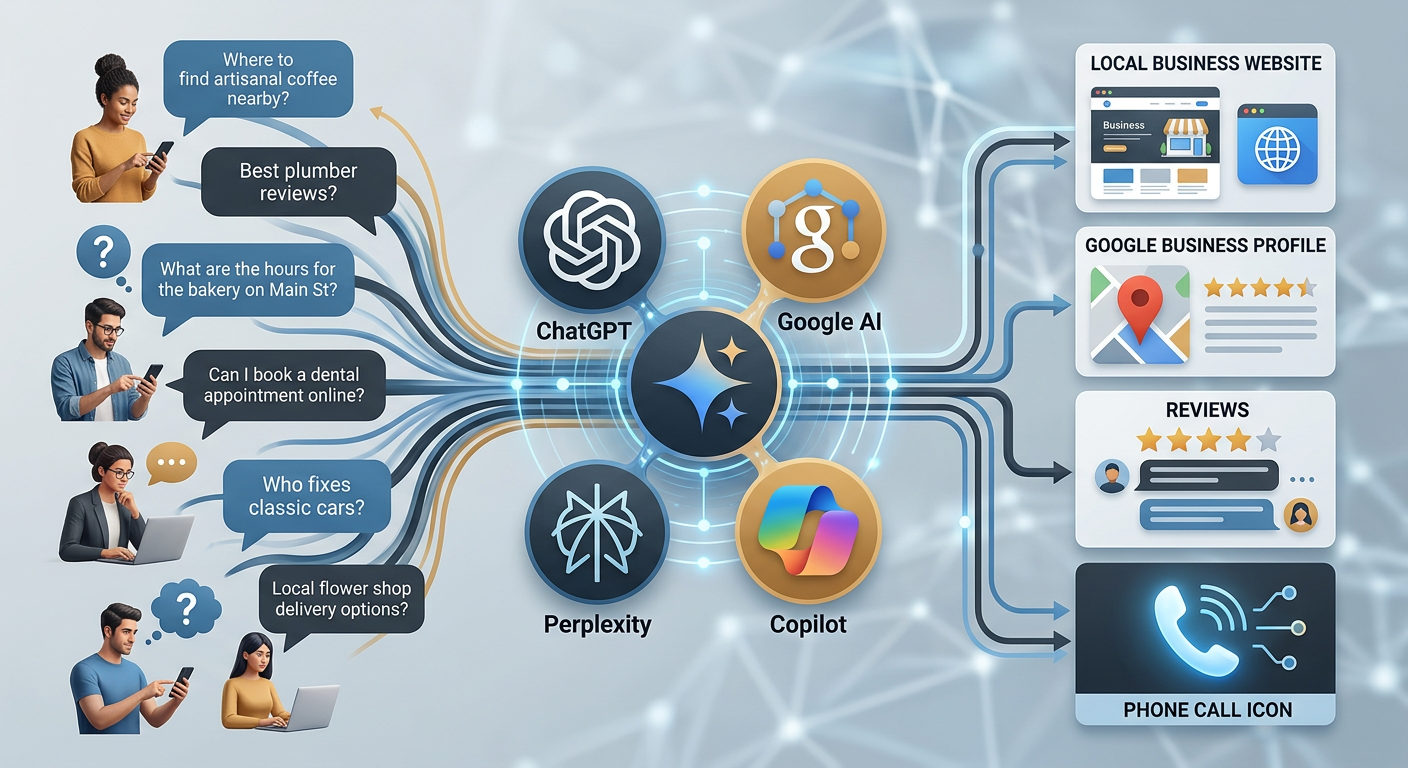
AI tracking is different from traditional keyword rank tracking. A standard rank tracker measures where a page appears in a list of search results. AI visibility platforms monitor how brands, products, services, and source pages appear within generated responses from platforms such as ChatGPT, Google AI, Gemini, Perplexity, and Microsoft Copilot.
The best systems typically measure:
- Brand mentions: How often your business is named in relevant responses.
- Share of voice: How often you appear compared with local or national competitors.
- Source links: Which pages, directories, publications, videos, and websites support the AI response.
- Prompt coverage: Which high-intent questions include your business, and which do not.
- Sentiment and positioning: Whether your brand is described accurately and favorably.
- Traffic and conversions: Whether visitors influenced by AI take meaningful actions after reaching your site.
Google has also begun rolling out a dedicated Generative AI performance report in Search Console for a subset of verified sites. It can show impressions, pages, countries, devices, and trends for Google AI features. That makes it a useful first-party source for measuring Google AI visibility, although availability is still expanding. Google Search Central
The most important limitation to understand
AI answers are not fixed rankings. Responses can vary by location, wording, timing, user context, and the platform being used. A tool can provide a disciplined trend line and competitive benchmark, but it cannot promise a single permanent position.
Google makes this point clearly in its guidance: "No third-party tool has access to our internal ranking or AI systems." Use tracking data to identify patterns and opportunities, then validate performance with your own website analytics, Search Console, conversion tracking, and real sales conversations. Google's guidance for AI features
A Quick Comparison of AI Visibility Tracking Options
| Tool or data source | Best fit | Useful strengths | Important tradeoff |
|---|---|---|---|
| Google Search Console | Any verified website | First-party Google AI impressions and pages | Limited rollout, Google only |
| Semrush AI Visibility | Small and mid-sized teams | Prompt tracking, competitors, AI readiness review | Starts at $99 per domain monthly when billed annually |
| Ahrefs Brand Radar | Brands needing broad research | AI share of voice, source analysis, custom prompts | Full multi-platform access can become costly |
| Manual prompt testing | Local service businesses | Real-world answer quality and local nuance | Hard to scale and standardize |
Google Search Console: the foundation, not the full answer
Search Console should be part of every measurement stack because it provides first-party data from Google. If your property has access to the Generative AI report, you can review which pages earn impressions in AI Overviews and AI Mode, then compare that activity with conversions in Google Analytics.
It is free, credible, and essential. However, it does not show how your company appears in ChatGPT, Claude, Perplexity, or Copilot, and it cannot tell you which competitor is winning an AI recommendation query outside Google.
Semrush AI Visibility: practical for structured team reporting
Semrush offers an AI Visibility plan that includes brand reporting, competitor analysis, prompt research, site-level AI readiness checks, and tracking across ChatGPT, Google AI, Gemini, and Perplexity. As listed on its pricing page on August 31, 2026, the Base plan starts at $99 per domain per month when billed annually and includes 25 custom prompts. Semrush AI Visibility pricing
This can be a practical fit for a marketing team that wants a familiar reporting environment and an organized way to track a defined list of revenue-focused prompts. The tradeoff is that a small prompt set can become restrictive for multi-location companies or businesses with multiple service lines.
Ahrefs Brand Radar: strong for broader market research
Ahrefs Brand Radar is designed to measure visibility across a large prompt database and track custom prompts across major AI platforms. It can help teams compare mentions, source links, competitor presence, and broader demand patterns. Ahrefs lists standalone access starting at $199 per month for one AI platform, while all-platform access is priced higher. Ahrefs Brand Radar
It is a better fit when you need more than a narrow list of tracked questions. For example, a regional law firm, medical group, real estate brand, or multi-location home service company may benefit from seeing how its brand appears across a wider market rather than only monitoring a few hand-selected prompts.
Manual testing: still valuable for local intent
No dashboard fully replaces careful manual review. A local business should regularly test questions a real customer would ask, such as:
- Who are the best cosmetic dentists in Scottsdale?
- Which Phoenix roofing company offers emergency repairs?
- Who should I hire for estate planning in Paradise Valley?
- What Scottsdale SEO company specializes in AI search visibility?
Record the prompt, location, platform, answer, named businesses, source links, and date. This gives your team context that automated reporting can miss, especially when a prompt includes local modifiers, service urgency, insurance constraints, or luxury-market expectations.
How We Choose the Right Metrics
Businesses often make the mistake of tracking too many prompts and too few outcomes. A growth-stage company should begin with a focused scorecard tied to buyer intent and expand only after the data proves useful.
Start with high-intent prompt groups
We recommend organizing prompts into groups based on the decision a prospect is trying to make:
- Recommendation prompts: “Best company for,” “who should I hire,” and “top providers near me.”
- Comparison prompts: “Company A versus Company B,” “best option for,” and “alternatives to.”
- Service prompts: Questions tied directly to revenue-producing services.
- Problem prompts: Questions asked when a buyer has an urgent need or pain point.
- Local prompts: City, neighborhood, service-area, and near-me variations.
A plumber, for example, should not make generic AI visibility the primary score. The business should measure prompts tied to water heater replacement, emergency leaks, sewer repair, financing, city coverage, and reputation. That is where lead value lives.
Track visibility, source quality, and business results together
A business mention is encouraging, but it is only one signal. We want to know whether the AI response includes your site, reputable third-party sources, your Google Business Profile information, consistent service details, positive reviews, and clear reasons to choose you.
Then we connect visibility to results. Watch branded organic searches, direct traffic trends, form submissions, tracked calls, booked consultations, and lead quality. AI influence may not always appear as a clean referral visit because a prospect can read an answer, remember your company, and search for you later.

What to Do When Competitors Keep Appearing Instead
If competitors are regularly recommended while your company is absent, do not assume the solution is to publish a large volume of generic AI content. Start by finding the missing evidence.
Review the sources behind the answers
Look at the pages and websites supporting the answer. Are competitors represented by strong service pages, industry publications, reviews, local directories, video content, comparison pages, or expert profiles? Do their websites explain services more clearly than yours?
This review often reveals practical work to do:
- Build stronger pages for your core services and locations.
- Improve Google Business Profile categories, services, photos, and review responses.
- Correct inconsistent business information across important directories.
- Add helpful FAQs that directly answer buyer questions.
- Strengthen author expertise, proof, testimonials, and case studies when verified.
- Use structured data that helps platforms understand your organization, services, locations, and content.
For businesses investing in AI search visibility, we combine this work with the fundamentals of traditional SEO. AI platforms need trustworthy, accessible information to work from. A weak website, thin service pages, inconsistent local data, and poor conversion paths undermine both Google performance and AI visibility.
Avoid treating the dashboard as the strategy
A tracking platform is an instrument panel, not the vehicle. If it tells you that your company has low visibility for “best Scottsdale orthodontist,” the next question is why. You may need better local authority, more complete service content, stronger reviews, clearer proof, better technical SEO, or a more useful page that matches the question.
This is where a human strategy matters. At Bemo Design, Brian Bemo and our team use tracking to identify where the real opportunity sits, then prioritize work based on lead potential, competition, and what will help your business become easier to understand and recommend across search channels.
Build a Measurement Routine Your Team Will Actually Use
A consistent monthly review is more useful than checking dashboards every day. AI-generated answers fluctuate, so overreacting to a single response can create wasted work.
A practical monthly workflow
- Review top recommendation, comparison, service, and local prompts.
- Compare your mention rate with the competitors that matter most.
- Identify source gaps, inaccurate descriptions, and unanswered buyer questions.
- Review Google AI impressions and landing-page performance in Search Console.
- Check analytics, calls, forms, appointments, and lead quality.
- Choose one to three priority improvements for the next month.
- Document what changed so your team can connect action with results.
For multi-location businesses, segment this work by city and service area. A brand might be visible in Phoenix but absent in North Scottsdale, or strong for one specialty service but weak for another. One overall score can hide the exact gap that is costing you leads.
See Where Your Business Appears Before You Invest More
If your company is unsure how it appears across Google and AI platforms, we can help you separate useful signals from dashboard noise. Bemo Design is a Scottsdale-based search visibility and lead generation company led by Brian Bemo, with more than 25 years of SEO and digital marketing experience.
Run a free AI SEO and website audit to review your website, Google visibility, and AI search opportunities. For local businesses focused on Google Maps and local discovery, use our free Local SEO, Google Maps, and AI audit, call (480) 600-2477, or book a free strategy call.
FAQ
What are AI search visibility tracking tools?
AI search visibility tracking tools monitor whether and how a business appears in AI-generated answers. They can measure brand mentions, competitor presence, source links, prompt coverage, and sometimes the traffic and conversions connected to AI discovery.
Can AI visibility tools track ChatGPT, Gemini, Claude, and Perplexity?
Some platforms monitor several AI systems, but coverage differs by provider and may change as platforms update access rules. Before buying, confirm the exact models, locations, prompt limits, update frequency, and reporting features that matter to your business.
Is Google Search Console enough for AI search tracking?
Google Search Console is essential for measuring your Google performance, including available data from Google AI features. It is not enough by itself if you also need to monitor brand visibility in third-party AI platforms or compare your mentions with competitors.
What is the best AI visibility metric for a local business?
The best metric is visibility for high-intent local questions that can produce calls or appointments, paired with leads and revenue. A broad mention score is less useful than knowing whether your company appears for questions about the services, neighborhoods, and problems that drive sales.
How often should we check AI search visibility?
Most businesses should review trend data monthly and use manual spot checks for important buyer questions. Weekly reviews can make sense during a major campaign, competitive shift, website launch, or local expansion.
Can better AI visibility improve Google Maps rankings?
AI visibility and Google Maps rankings are related through shared trust signals, but one does not automatically cause the other. Strong reviews, accurate business information, complete service details, local authority, and a helpful website can support both, which is why a connected strategy is more effective.
The Bottom Line
The right tools help you see whether AI platforms understand your business, which competitors are being recommended, and where your information needs to improve. They do not replace sound SEO, a strong Google Business Profile, credible proof, conversion-focused pages, or real measurement of calls and leads.
For growth-focused brands, the opportunity is to make AI visibility part of a broader search strategy. Track the questions that matter, validate the answers, improve the evidence behind your brand, and measure success by the qualified customers who choose you.
Summary
AI visibility tracking helps businesses monitor how they appear in generated answers, compare competitive presence, and identify source gaps that affect recommendations. The best approach combines third-party tools, Google Search Console, manual testing, and conversion data so marketing decisions remain tied to actual business growth.
About Bemo Design
Bemo Design is a Scottsdale-based SEO, AI search, Google Ads, Local SEO, and digital marketing company led by Brian Bemo. With more than 25 years of experience, Bemo Design helps businesses increase visibility across Google Search, Google Maps, Google Business Profile, ChatGPT, Google AI, Gemini, Claude, Perplexity, Bing/Copilot, and other AI search platforms.
Our strategy combines traditional SEO, GEO AI SEO and AI Search Optimization, Google Business Profile optimization, Google Maps visibility, reviews, content, schema, authority building, Google Ads, and conversion-focused web design.
The goal is simple: help businesses get found, trusted, recommended, and chosen, then turn that visibility into real calls, leads, appointments, and customers.
Explore Bemo Design's AI Search Resources
AI SEO Services in Scottsdale →
See How Your Business Is Performing
RUN A FREE AI SEO + WEBSITE AUDIT →
RUN A FREE LOCAL SEO + GOOGLE MAPS + AI AUDIT →
Ready to Get More Leads?
Call (480) 600-2477