Website Not Converting Leads? 9 Fixes for More Qualified Leads

Website Not Converting Leads? 9 Fixes for More Qualified Leads
A website can look polished, rank for a few terms, and still fail at its real job: turning interested visitors into calls, form submissions, appointments, and sales conversations. If your website not converting leads problem has been hanging around for months, the issue is rarely one isolated button or headline. It is usually a combination of unclear messaging, weak proof, friction, and a visitor journey that does not match how customers make decisions.
For growth-stage businesses in Scottsdale, Phoenix, Paradise Valley, and across Arizona, we see this often. Owners spend money on SEO, Google Ads, referrals, and social media, then send every prospect to a website that gives them little reason to act. The good news is that conversion problems can be diagnosed and fixed without guessing.
Summary
A lead-generating website makes three things obvious within seconds: what you do, who you help, and why a customer should choose you. It also gives visitors a low-friction next step, whether that is calling, booking, requesting an estimate, or submitting a short form.
The goal is not more traffic for its own sake. The goal is more qualified opportunities from the traffic you already earn, then a stronger foundation for long-term Google and AI visibility.
Why Good-Looking Websites Still Underperform
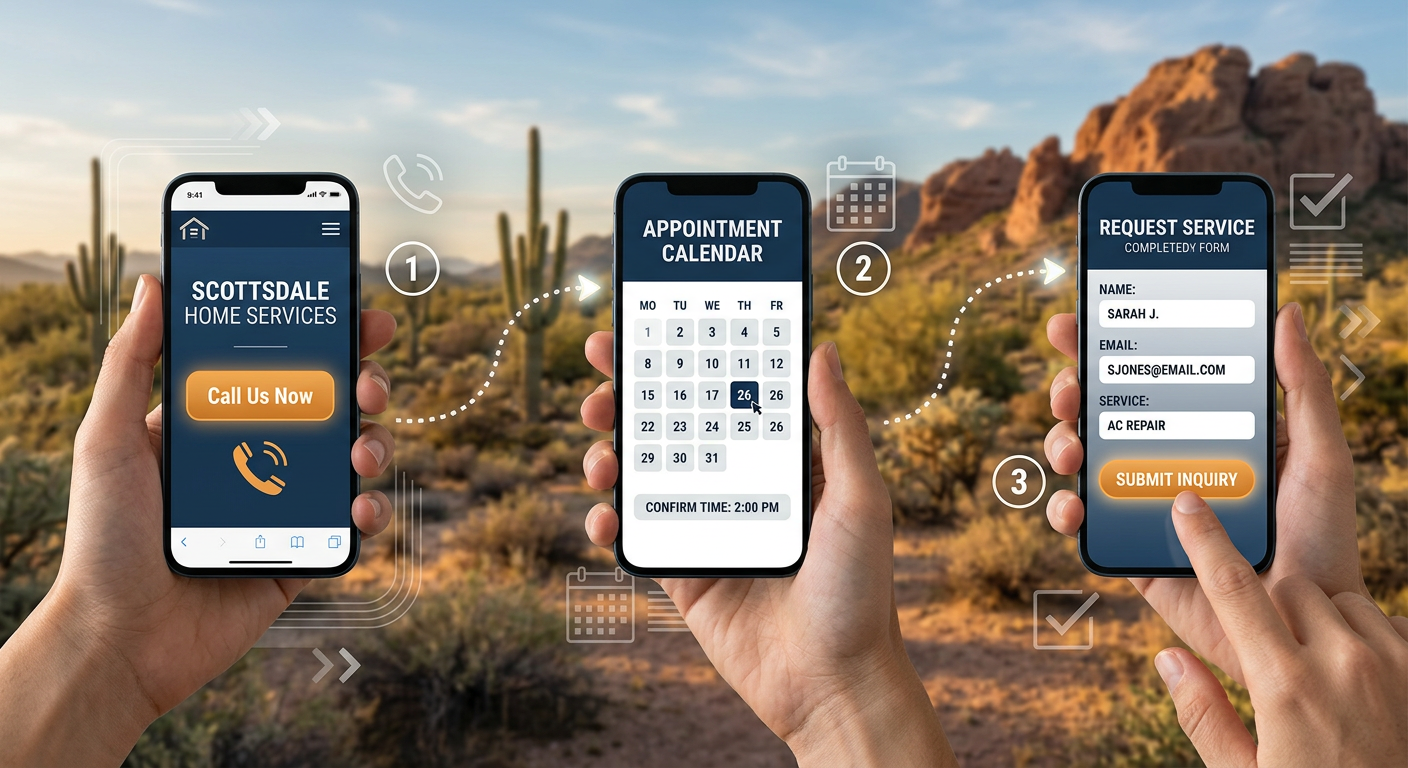
A visually attractive site is not automatically persuasive. Visitors arrive with a question, a need, or a problem to solve. If the page makes them work to understand the offer, find pricing guidance, locate proof, or figure out how to contact you, they often leave and compare another company.
Speed matters, too. In a Google mobile performance study, Google reported that 53% of mobile visits were abandoned when a page took longer than three seconds to load. The data is from March 2016, but the practical lesson remains relevant: a slow first impression creates an avoidable leak in your lead pipeline.
For established local companies and professional service firms, the most common problem is not a lack of effort. It is that the site was built as an online brochure instead of a sales asset.
9 Fixes When Your Website Is Not Converting Leads
1. Make Your Value Clear Above the Fold
Your homepage should quickly answer three questions: What do you do? Who do you help? Why should someone trust you? Do not lead with vague phrases such as “innovative solutions” or “exceptional service” unless you immediately explain what that means for the buyer.
A Scottsdale dental practice, law firm, pool builder, or restoration company should clearly state its service, service area, primary benefit, and preferred action near the top of the page. Visitors should not have to scroll to understand whether they are in the right place.
2. Give Every Important Page One Primary Next Step
Too many choices slow people down. A service page should have one main conversion goal, such as booking a consultation, requesting an estimate, calling the office, or scheduling an appointment.
You can still offer a secondary option for people who are not ready, such as downloading a guide or viewing project examples. But the primary action should be visually clear, repeated naturally down the page, and easy to complete on a phone.
3. Replace Generic Claims With Specific Proof
Trust is the difference between browsing and contacting. Instead of saying you provide “quality work,” show what supports that claim: real reviews, case studies, credentials, years in business, project photos, process details, recognizable affiliations, and answers to common concerns.
For high-value services, visitors often need reassurance before they reach out. A homeowner comparing luxury remodeling firms or a patient choosing a medical provider wants evidence that the business is established, responsive, qualified, and right for their situation.
4. Shorten and Improve Your Lead Forms
A long form can feel like work, especially on mobile. Ask only for the information your team truly needs to begin a productive conversation. For many businesses, name, phone, email, service needed, and a short message are enough.
Set clear expectations beside the form. Let visitors know when you will respond, whether estimates are available, and what happens after they submit. That small amount of clarity lowers hesitation and helps your team receive better inquiries.
5. Build Service Pages Around Buyer Intent
Traffic does not convert when the landing page is too broad. A visitor who needs emergency water damage restoration, cosmetic dentistry, business litigation, or luxury interior design needs a page that speaks directly to that service and the decision they are making.
Strong service pages explain the problem, the solution, the process, the proof, and the next step. They also support visibility in Google by giving each important service its own clear, useful home rather than burying everything on one generic page.
This is one reason a strategic website redesign often outperforms a cosmetic refresh. The work starts with business goals and conversion paths, then design supports that strategy.
6. Treat Mobile Experience as a Revenue Issue
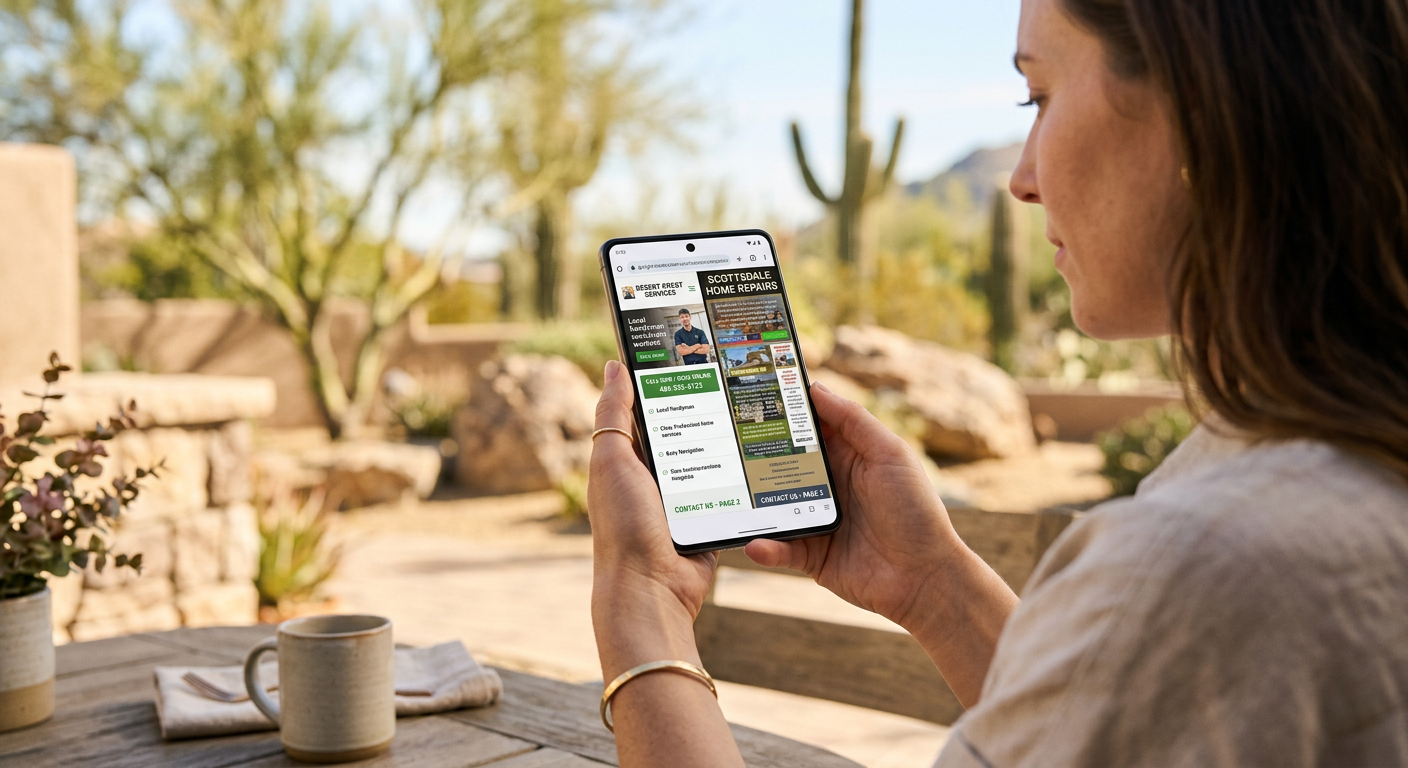
Most local prospects will visit your site on a phone, often while comparing providers between meetings, from a jobsite, or at home after work. Your click-to-call number, forms, navigation, service details, and booking links need to work without pinching, zooming, or hunting through menus.
Test your site as a real customer would. Can you find a core service in one tap? Can you call in one tap? Can you submit a form without typing a paragraph? If not, mobile friction may be costing you leads that your analytics cannot fully explain.
7. Align Ads, SEO, and Landing Pages
A Google Ads campaign can send highly motivated visitors to your business, but it cannot rescue a weak landing page. The same is true for organic traffic. If the page does not match the promise of the ad, the keyword intent, or the visitor's location and service need, you pay for clicks without creating enough opportunities.
We recommend reviewing the full path: ad or listing, landing page, call to action, form, confirmation message, and follow-up process. Businesses using Google Ads management should pay close attention to this alignment because a better page can improve lead quality without increasing ad spend.
8. Measure the Leads That Actually Matter
Do not stop at pageviews or form totals. Track phone calls, booked appointments, quote requests, qualified consultations, cost per lead, and the percentage of leads that become customers.
A form filled with spam or poor-fit inquiries is not a win. Growth-stage businesses need to know which pages generate real revenue opportunities, which channels bring the best prospects, and where the sales process is losing momentum after the first contact.
9. Make Your Website Easy for People and AI Platforms to Understand
Clear structure is good for customers and good for visibility. Your site should consistently explain your company, services, locations, experience, proof, and differentiators through organized pages, useful FAQs, internal links, accurate business details, and structured data.
That foundation helps traditional SEO and makes it easier for AI platforms to identify what your business does when people ask recommendation-style questions. Our GEO AI SEO services connect this visibility work with practical conversion strategy, because being found only matters if the visitor sees a compelling reason to contact you.
Find the Leaks Before You Rebuild Everything
Not every underperforming website needs a complete replacement. Sometimes the fastest gains come from rebuilding a core service page, simplifying a form, strengthening proof, improving mobile speed, or creating dedicated landing pages for high-intent campaigns.
At Bemo Design, we review your site as part of your full lead-generation system, including SEO visibility, paid traffic, messaging, user experience, and conversion tracking. Brian Bemo brings more than 25 years of hands-on digital marketing experience to help businesses make practical improvements that support real growth.
Want to see how your business performs in Google and AI search?
RUN YOUR FREE AI SEO + WEBSITE AUDIT →
You can also call (480) 600-2477 or book a free strategy call to discuss what may be holding your website back.
Questions Business Owners Ask About Website Conversions
Why does my website get traffic but no leads?
Traffic may be poorly matched to your offer, or the landing page may not give visitors enough clarity, trust, or reason to act. Review your top landing pages first, then compare the visitor's likely intent with the page message and call to action.
What is a good website conversion rate for a service business?
There is no single benchmark that applies to every business. A specialized medical practice, emergency home service company, luxury brand, and B2B consulting firm will have different traffic quality, sales cycles, and conversion actions. Focus on improving your own qualified lead rate and cost per qualified lead over time.
Should I redesign my website or improve the pages I have?
Start with an audit. If the site has sound technology, useful content, and a workable structure, targeted improvements may be enough. If it is outdated, hard to use on mobile, difficult to update, or missing clear conversion paths, a redesign may be the better investment.
Will better website design help my Google rankings?
Design alone does not create rankings. However, a properly planned redesign can improve mobile usability, speed, content structure, internal linking, technical SEO, and engagement, all of which create a stronger foundation for visibility. Learn more about SEO services in Scottsdale if your site needs both conversion and visibility improvements.
How quickly can conversion improvements produce more leads?
Simple changes, such as clearer calls to action or a shorter form, can have an impact as soon as the page receives qualified visitors. Larger improvements involving content, technical performance, SEO, and advertising alignment should be measured over a longer period so you can separate meaningful progress from normal fluctuations.
Can a website help my business appear in ChatGPT and Google AI results?
A well-organized website with clear service information, real expertise, location relevance, proof, useful content, and consistent business details gives AI systems stronger context about your company. For more guidance, review how to show up in ChatGPT.
The Bottom Line
When a website is not producing leads, it is tempting to blame traffic. But many businesses already have enough visitors to create more opportunities. What they lack is a clear, fast, credible experience that helps the right prospect move from interest to action.
Start with the basics: clarify your offer, remove friction, strengthen proof, improve mobile usability, and track what happens after a visitor reaches the page. Then build on that foundation with better service pages, smarter campaigns, and a website designed to support the way customers actually choose a company.
About Bemo Design
Bemo Design is a Scottsdale-based SEO, AI search, Google Ads, Local SEO, and digital marketing company led by Brian Bemo. With more than 25 years of experience, Bemo Design helps businesses increase visibility across Google Search, Google Maps, Google Business Profile, ChatGPT, Google AI, Gemini, Claude, Perplexity, Bing/Copilot, and other AI search platforms.
Our strategy combines traditional SEO, GEO AI SEO and AI Search Optimization, Google Business Profile optimization, Google Maps visibility, reviews, content, schema, authority building, Google Ads, and conversion-focused web design.
The goal is simple: help businesses get found, trusted, recommended, and chosen, and turn that visibility into real calls, leads, appointments, and customers.
Explore Bemo Design's AI Search Resources
AI SEO Services in Scottsdale →
See How Your Business Is Performing
RUN A FREE AI SEO + WEBSITE AUDIT →
RUN A FREE LOCAL SEO + GOOGLE MAPS + AI AUDIT →
Ready to Get More Leads?
Call (480) 600-2477