Google Ads for Dental Practices: A Strategy for More Patients
Google Ads for Dental Practices: A Strategy for More Patients
A full schedule rarely happens by accident. When someone nearby needs an emergency dentist, dental implant consultation, Invisalign provider, or family dental appointment, they often make a decision quickly. The practice that appears with a clear offer, strong reviews, and an easy way to call has a real advantage.
That is why Google Ads for dental practices can be such a powerful patient acquisition channel. Done well, it places your practice in front of high-intent local prospects at the moment they are actively looking for care. Done poorly, it becomes an expensive stream of clicks that never become booked appointments.
The numbers reinforce why details matter. WordStream’s 2025 industry benchmarks reported that dentists and dental services averaged a 9.08% conversion rate, a $7.85 average cost per click, and an $83.93 average cost per lead. Those are useful reference points, not guarantees, because service mix, competition, website quality, response speed, and treatment value all affect profitability. Read the WordStream benchmark report.
What a Profitable Dental Google Ads System Looks Like
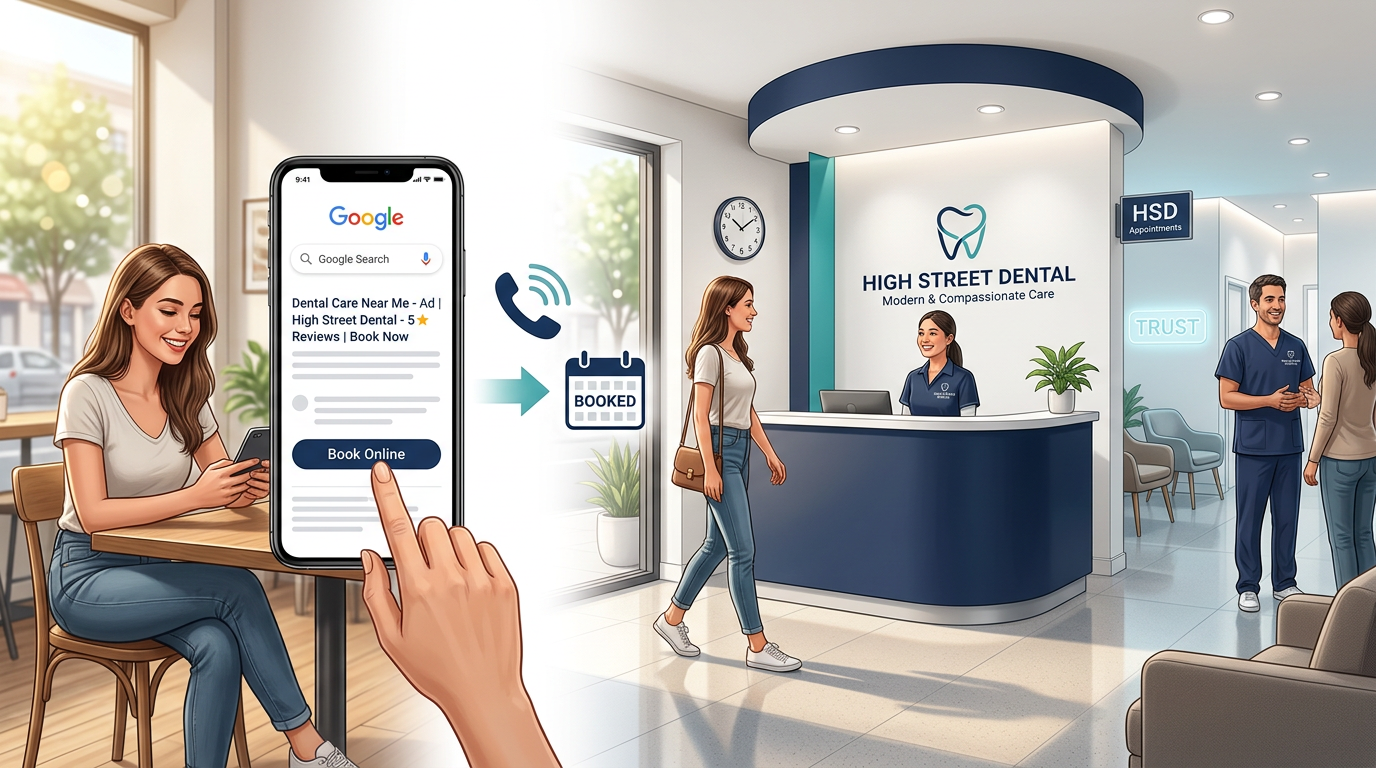
A successful campaign is not simply an ad account. It is a connected lead generation system built to attract the right patient, create confidence, capture the call or form submission, and help your team book the appointment quickly.
| System Element | What It Does | What To Measure | Common Mistake |
|---|---|---|---|
| High-intent keywords | Reaches ready-to-book patients | Calls and qualified forms | Targeting broad research terms |
| Local ad copy | Makes your practice the clear choice | Click-through rate | Generic promises |
| Dedicated landing page | Converts visits into inquiries | Lead conversion rate | Sending traffic to the homepage |
| Call tracking | Connects spend to real calls | Qualified calls and bookings | Counting every click as a lead |
| Fast follow-up | Converts inquiries into appointments | Lead-to-booking rate | Waiting until the next day |
The big shift is mindset. We do not judge results by impressions, clicks, or a dashboard full of activity. We judge results by qualified calls, booked consultations, accepted treatment plans, and revenue that can be connected to your marketing investment.
Build Campaigns Around Treatments That Drive Revenue
Not every dental service deserves the same budget or campaign structure. A general dentistry practice may need steady new-patient volume, while a cosmetic or implant-focused office may be more concerned with the lifetime value of a smaller number of consultation requests.
Separate High-Value Treatments From General Dentistry
We recommend dedicated campaigns for services with different economics and patient motivations. For example, dental implants, Invisalign, emergency dentistry, cosmetic veneers, and same-day crowns should not all compete within one generic ad group.
A patient looking for an emergency dentist wants immediate availability, location clarity, and a phone number. A dental implant prospect often needs financing information, credibility signals, before-and-after examples where appropriate, and a consultation-focused page. Matching the message to the intent improves relevance and helps control wasted spend.
Use Local Intent, Not Just Broad Reach
Local geography is one of the biggest advantages dental practices have. Your ads should focus on cities, neighborhoods, and realistic driving areas where patients are likely to book and show up.
For practices in Scottsdale, Phoenix, and across Maricopa County, that can mean prioritizing location-driven phrases alongside treatment terms, then reviewing performance by area. The goal is not to reach everyone. It is to reach the people most likely to become patients.
Make the Landing Page Earn the Click
Here is the thing: even excellent ads cannot fix a weak page. If a visitor lands on a generic homepage, has to hunt for the right treatment, cannot see why your practice is credible, or struggles to call on mobile, your cost per lead rises fast.
A strong dental landing page should include:
- A treatment-specific headline that mirrors the ad
- A clear local trust signal, such as your city or service area
- A prominent click-to-call button for mobile visitors
- A simple appointment request form
- Insurance, financing, or payment information when relevant
- Patient reviews, doctor credentials, and practice differentiators
- Clear next steps, so prospects know what happens after they reach out
This is where conversion-focused web design matters. Your ads create the opportunity, but the page determines whether that opportunity becomes a phone call. If your site is dated or hard to navigate, a focused website redesign strategy can improve the entire funnel, not just the look of the practice.
Track Calls, Forms, Bookings, and Accepted Treatment
Many dental offices stop tracking too early. They see a form submission or a phone call and call it a win. But a lead is only the beginning.
We recommend tracking the full path from ad click to inquiry, booked appointment, attended consultation, and accepted treatment whenever your systems allow it. That makes it possible to identify which campaigns bring real patients instead of low-quality inquiries, job seekers, insurance questions, or wrong-number calls.
For example, a campaign that produces fewer leads at a higher cost may still be the better investment if it consistently brings implant consultations that accept treatment. This is why raw cost per lead is not enough. Cost per booked patient and cost per accepted case are more meaningful business metrics.
Keep Front-Desk Follow-Up in the Plan
Speed matters because prospective patients often contact more than one practice. Build a clear handoff process before campaigns launch:
- Answer live calls whenever possible.
- Return missed calls quickly.
- Contact form leads by phone and text with appropriate consent.
- Use a simple script to guide the conversation toward an appointment.
- Record booking outcomes so marketing decisions improve over time.
A smart campaign cannot overcome a slow or inconsistent response process. Your front desk is part of the marketing system.
Stay Compliant With Healthcare Advertising Rules
Dental advertising must be accurate, professional, and mindful of healthcare-related platform policies. Google classifies health content as a sensitive interest area, which limits certain personalized advertising options. That means campaigns should prioritize lawful, transparent messaging and patient intent rather than relying on invasive audience tactics. Review Google’s health advertising policy.
Avoid unsupported claims, misleading urgency, or copy that implies you know a user’s private medical condition. Keep promotions clear, disclose meaningful terms, and make sure your website reflects the services you advertise. When in doubt, review the policy before scaling a new campaign.
Google Ads, Organic Visibility, and AI Recommendations Work Better Together
Paid ads can create immediate demand capture, while organic visibility builds a durable pipeline. The strongest dental marketing plans use both.
A practice can run campaigns for high-value treatments today while building location pages, treatment content, reviews, local authority, and structured information that support organic Google visibility over time. It should also prepare the practice to be understandable and recommendable in AI-driven platforms, where more people are asking for local provider recommendations instead of clicking through long result pages.
Our GEO AI SEO approach helps businesses build the clear content, credibility, and local signals that support visibility across Google and AI answer platforms. Paid media gets you in the conversation quickly. Long-term authority helps your practice keep getting chosen.
Choosing Between In-House Management and Outside Help
There is no one right answer for every practice. The right model depends on your budget, internal expertise, time, and ability to respond to leads.
Managing Ads Internally
In-house management can work when someone on your team understands keyword intent, conversion tracking, policy requirements, bidding, landing page testing, and reporting. You avoid a management fee, but you take on the cost of training, software, testing, and missed opportunities while learning.
Hiring a Freelancer
A freelancer may be a practical fit for a smaller budget or a simple campaign. Ask how often they optimize accounts, how they track calls, whether they improve landing pages, and whether they report on booked appointments rather than surface-level metrics.
Working With a Lead Generation Agency
An experienced agency is usually the best fit when you want ads, landing pages, tracking, local SEO, and follow-up strategy to work as one system. Bemo Design offers Google Ads management with a hands-on approach built around measurable calls and leads, not set-it-and-forget-it campaign management.
With more than 25 years of experience, Brian Bemo works directly with clients to align ads with conversion funnels, website performance, SEO, and real business goals. That personal involvement matters when your practice needs strategic decisions, honest reporting, and fast communication.
Common Questions About Dental Google Ads
How much should a dental practice spend on Google Ads?
Start with a budget that can generate enough qualified clicks and conversions to make informed decisions. The right amount depends on your market, services, competition, patient value, and goals. Rather than choosing a number in isolation, calculate what a new patient or accepted treatment case is worth to your practice.
Are Google Ads worth it for dentists?
They can be highly worthwhile when campaigns focus on high-intent treatments, direct prospects to relevant pages, and track booked appointments. They are less effective when the account targets vague terms, sends traffic to a generic homepage, or ignores lead follow-up.
What dental services work best with paid ads?
Emergency dentistry, dental implants, Invisalign, cosmetic dentistry, new-patient offers, same-day appointments, and other treatment-specific services often work well because the prospect has a clear and timely need. Each service should be evaluated based on its value, competition, and ability to convert inquiries into care.
How long does it take for dental ads to work?
A campaign can generate calls soon after launch, but meaningful optimization takes time. We generally need enough conversion data to identify what is producing qualified inquiries, then refine keywords, ads, locations, budgets, and landing pages based on outcomes.
Should dental practices use Performance Max campaigns?
They can have a role, but they should not replace a disciplined local intent strategy. For many practices, core search campaigns provide clearer control over keywords, ad messaging, and budget allocation. Performance Max may become useful after tracking is reliable and the practice has strong creative assets and conversion data.
Can Google Ads help a new dental practice compete locally?
Yes. Paid ads can help a new office appear alongside established competitors while organic visibility grows. The advantage comes from a focused offer, a credible page, excellent call handling, and a consistent local brand experience.
Ready to Build a Dental Lead Generation System?
If you want more than clicks, we can help you build a practical plan for calls, consultation requests, and booked patients. Bemo Design combines Google Ads, high-intent SEO, AI visibility, and conversion funnels so your practice can compete where local decisions are being made.
Call (480) 600-2477 or book a free strategy call. You can also begin with a free AI SEO audit to identify missed opportunities across your website and local visibility.
Key Takeaway
Google Ads for dental practices works best when it is treated as a complete patient acquisition system, not a quick traffic purchase. Focus on high-value local intent, service-specific landing pages, accurate tracking, fast follow-up, and honest measurement tied to booked care.
The practices that win are not necessarily the ones spending the most. They are the ones that make it easiest for the right patient to find them, trust them, contact them, and book.
About Bemo Design
Bemo Design is a Scottsdale-based digital marketing agency led by Brian Bemo, specializing in SEO, Google Ads, and AI-powered visibility.
We help businesses get found across Google and AI-driven platforms, then convert that visibility into real leads, calls, and revenue. With more than 25 years of experience, we focus on high-intent strategies, conversion funnels, and measurable growth.
Our Core Services
Ready to Get More Leads?
Call (480) 600-2477
Or run a Free AI SEO Audit.