How to Get Recommended by AI Search: Build Real Trust Signals

How to Get Recommended by AI Search: Build Real Trust Signals
Being visible in Google is no longer the whole job. When a potential customer asks an AI platform who they should hire, the business that is easiest to verify, understand, and trust has a stronger chance of being mentioned.
How to get recommended by AI search starts with the same fundamentals that make a business credible to people: a clear website, accurate business information, proof of experience, useful answers, and a reputation that holds up across the web. There is no switch that guarantees a recommendation, but you can build the signals that make your company a more reliable candidate.
For local businesses, professional firms, medical practices, home-service companies, and high-value service providers, this matters because AI-driven questions often carry strong buying intent. A person asking for the best Scottsdale accountant, cosmetic dentist, roofer, attorney, or marketing firm may be close to making a decision.
AI Platforms Recommend Businesses They Can Understand and Verify
AI recommendations are usually based on information that is clear, relevant, and supported across multiple sources. Your goal is to make it easy for systems and prospective customers to confirm who you are, what you do, where you work, and why you are qualified.
Google’s guidance for AI Overviews and AI Mode is direct: standard SEO best practices still apply. Google also states that there are no additional technical requirements to be eligible for these features beyond being indexed and eligible to appear with a snippet in Google Search.
That does not mean a basic website is enough. It means your foundation has to be strong before advanced AI visibility work can produce meaningful results.
| Signal | What AI Systems Need to See | Business Example |
|---|---|---|
| Clear entity information | Consistent name, services, location | Same business details on website, Maps, and directories |
| Useful expertise | Direct answers with real context | A detailed service page that explains process and fit |
| Independent proof | Reviews, mentions, credentials | Verified reviews and reputable third-party profiles |
| Technical access | Crawlable, well-structured pages | Fast pages, logical navigation, clean indexing |
| Local relevance | Accurate service-area signals | Google Business Profile, location pages, local proof |
The key is consistency. If your website says one thing, your Google Business Profile says another, and directory listings are incomplete, it creates uncertainty. Strong brands reduce that uncertainty everywhere a customer or AI system looks.
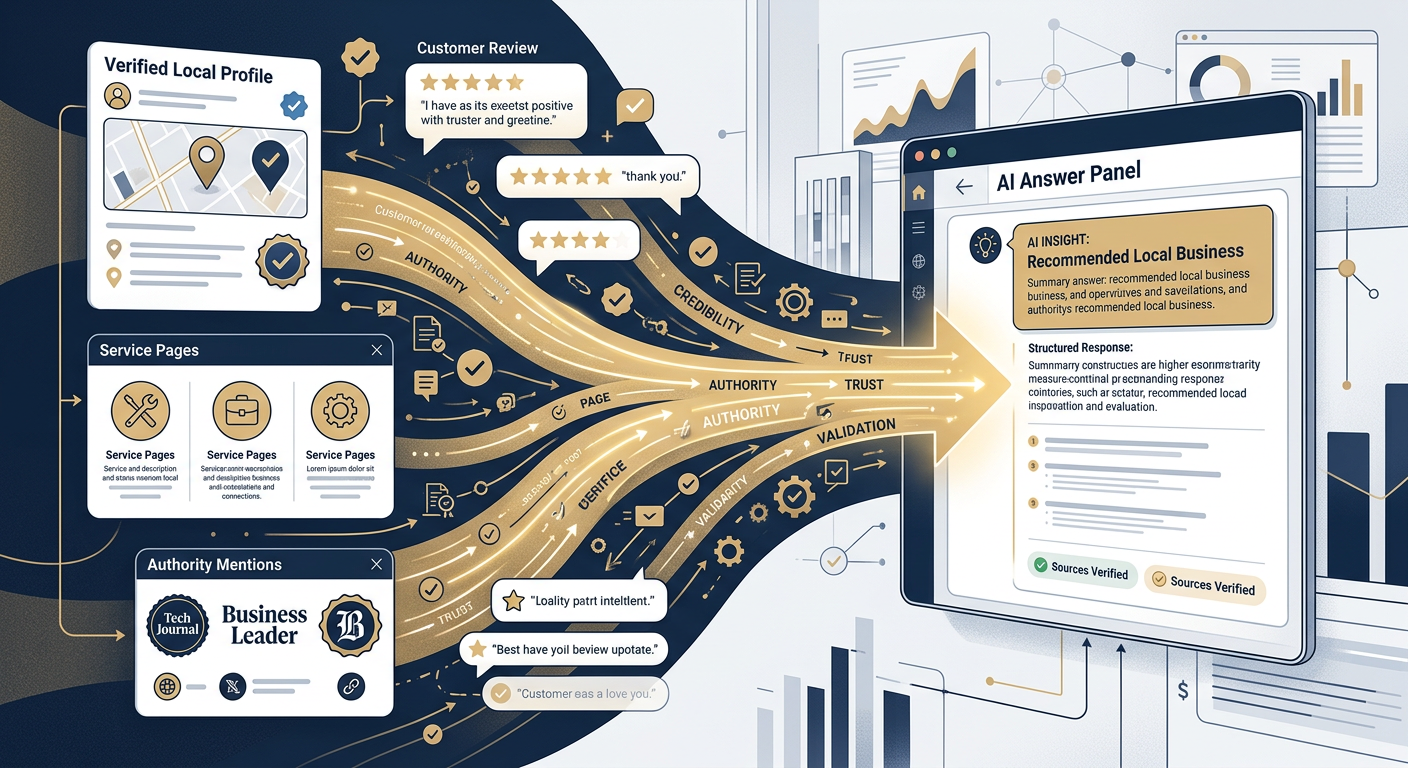
Build a Business Entity, Not a Collection of Random Pages
A business entity is the complete, connected picture of your company across your website and the wider web. It gives AI systems enough context to distinguish your business from similarly named companies and understand its real-world expertise.
Start by documenting the basics with care:
- Your exact business name
- Physical address or service area
- Primary phone number
- Core services and specialties
- Primary markets served
- Leadership and subject-matter expertise
- Credentials, licenses, associations, and awards you can verify
- Consistent logo, business description, and company story
We also recommend that service businesses give each major service a dedicated, useful page. A generic “Services” page may be fine for navigation, but it rarely gives a platform enough detail to connect your company with specific customer needs.
For example, a Phoenix law firm should not rely on a single broad legal-services page. It needs pages that clearly explain relevant practice areas, client fit, location coverage, attorney experience, process, and common questions. The same principle applies to contractors, dentists, real estate professionals, consultants, and other local service providers.
Schema markup can reinforce this information for machines, but it cannot rescue vague or inaccurate content. Use structured data to support what people can already see on the page, including organization, local business, service, person, review, and FAQ details when appropriate.
Publish the Specific Answers Buyers Ask AI Platforms
AI platforms work best when a business has clear pages that answer real questions. Thin service pages and recycled blog posts leave too much for the system to guess.
Build content around the conversations your buyers are already having:
- Who should I hire for this service in my area?
- What should I look for before choosing a provider?
- How much does this service typically cost?
- What is included, and what is not?
- How long does the process take?
- Which option is right for my situation?
- What makes one provider more qualified than another?
Answer the question first, then provide the practical detail that proves you understand the work. Use clear headings, concise paragraphs, comparison tables where they help, and examples based on actual client situations without exposing private information.
Firsthand experience is difficult to replace. A local HVAC company can explain how monsoon-season demand affects scheduling in the Phoenix area. A Scottsdale financial advisor can explain the questions business owners should ask before choosing an advisor. Those details are more useful than generic copy because they demonstrate real proximity to the customer’s problem.
OpenAI’s publisher guidance says public websites can appear in ChatGPT results and recommends allowing its crawler access when you want content discovered, surfaced, and linked. Review the OpenAI publisher FAQ with your web team to confirm that you are not unintentionally blocking access to pages you want customers to find.
Earn Proof Beyond Your Own Website
Your website is where you explain your expertise. Independent sources are where other people confirm it. Both matter when you want to be recommended instead of merely mentioned.
Build a durable proof system that includes:
Reviews That Describe Real Service Experiences
Ask for honest reviews after a completed job, appointment, purchase, or engagement. Do not script reviews or chase a perfect star rating at the expense of authenticity.
The best reviews naturally mention the service provided, the customer’s experience, and details that future buyers care about. Respond to reviews professionally, including the occasional critical one, because your response is also part of your public reputation.
Accurate Local Listings and Directories
For a local company, your Google Business Profile, Apple Business Connect profile, industry directories, social profiles, and key local listings should agree on the basics. Inconsistent names, phone numbers, addresses, categories, or service descriptions make verification harder.
Your Google Business Profile deserves ongoing attention. Keep categories accurate, services complete, photos current, business hours correct, and posts useful. Strong Google Maps visibility and local reputation also support the broader credibility signals customers encounter during AI-assisted research.
Credible Third-Party Mentions
Look for legitimate opportunities to be included in local associations, trade organizations, partner pages, respected publications, event sponsorships, and community resources. A few relevant, trustworthy mentions are more valuable than dozens of low-quality listings.
Do not buy links, invent awards, or publish fake testimonials. AI systems can produce incorrect answers, and they can also surface negative evidence when a company’s public footprint looks manipulative or inconsistent.
Use a Progressive Content Strategy Instead of Publishing at Random
A reliable AI visibility program grows in stages. The goal is not to publish more pages than your competitors. The goal is to close the biggest credibility and conversion gaps first.
Days One Through Five: Establish the Baseline
During the first five days, we recommend checking how your business appears for high-intent prompts across Google, Google Maps, ChatGPT, Gemini, Claude, Perplexity, and Bing/Copilot. Record the businesses that appear most often, the sources they are associated with, and the service questions they answer well.
Then audit your own foundation:
- Can customers quickly understand your core services?
- Are your business details consistent everywhere?
- Are your most important pages indexed and easy to navigate?
- Do you have proof that supports your claims?
- Do your reviews, maps profile, and website tell the same story?
This five-day baseline prevents a common mistake: creating more content before fixing the pages and profiles that should already be earning trust.
Weeks Two Through Four: Fill the High-Intent Gaps
Next, improve your core service pages, location pages, leadership pages, FAQs, and comparison content. Focus on the questions that influence a hiring decision, not broad topics that attract readers with no need to buy.
For a multi-location company, make every location page distinct and useful. Include genuine local details, local team information when available, specific service availability, directions or service-area context, and locally relevant proof. Duplicating the same page and swapping city names creates a weak experience for customers and a weak signal for platforms.
Ongoing: Measure Recommendations, Not Just Rankings
Traditional rank tracking still matters, but it is not enough. Monitor whether your business appears in AI-generated answers for recommendation questions, which competitors are mentioned, what source types show up, and whether visitors from those channels take action.
The best outcome is not a vanity mention. It is a qualified visitor who calls, requests an estimate, schedules an appointment, or books a consultation.
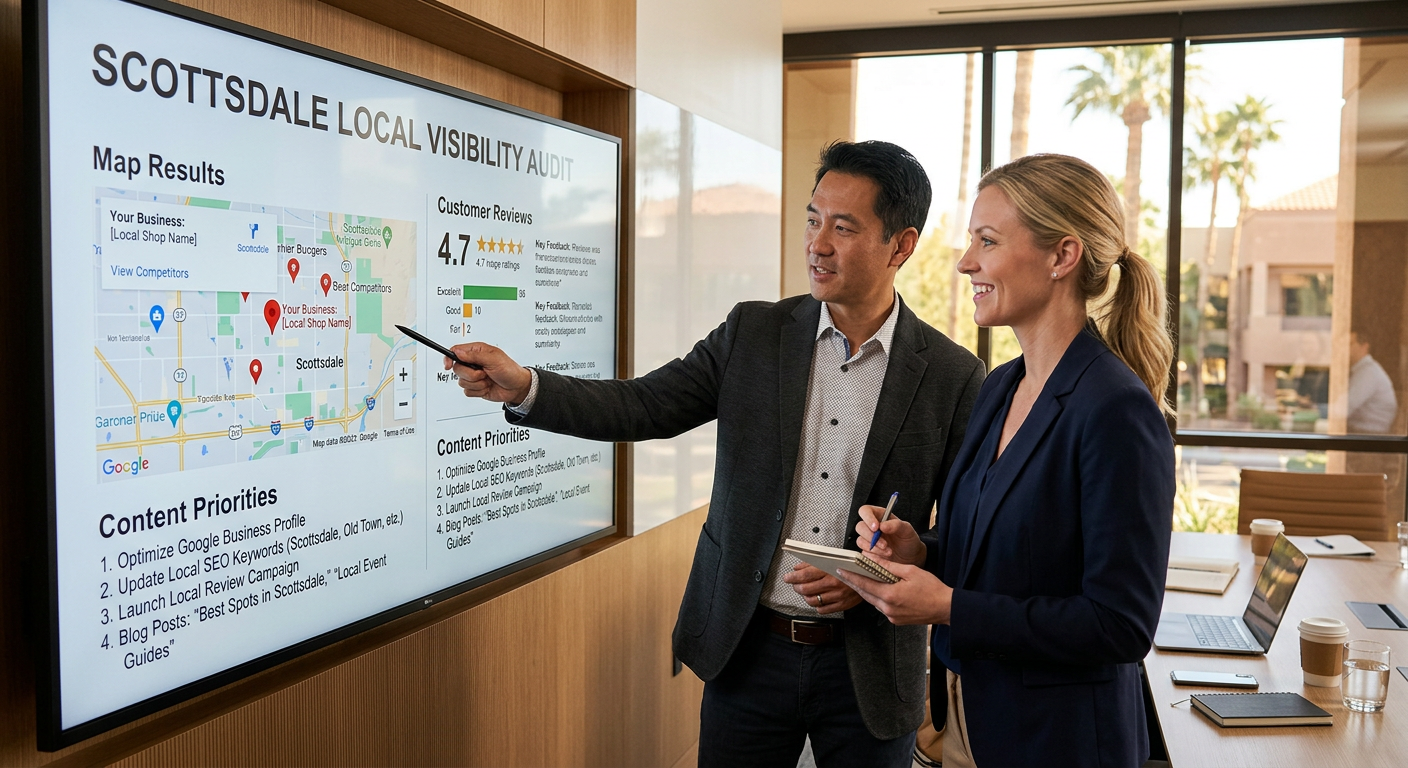
Strengthen the Pages That Convert AI Visibility Into Leads
A recommendation only helps if the customer lands on a page that builds confidence and makes the next step easy. Too many businesses spend heavily on visibility, then send traffic to generic pages with weak messaging and unclear calls to action.
Every high-intent page should make these points obvious:
- What you do
- Who you help
- Where you work
- What makes your approach credible
- What a customer should expect next
- How to contact you without friction
Add proof near the decision point. That may include verified reviews, project examples, credentials, team biographies, before-and-after examples, process explanations, and clear service boundaries. Make your phone number clickable on mobile, use short forms, and avoid asking for unnecessary information before a prospect can speak with someone.
At Bemo Design, we connect these visibility signals with conversion-focused website work because being found is only the first half of the job. Our AI SEO services are built around helping businesses become easier to understand, validate, and choose across Google and AI-driven platforms.
Find the Gaps Before Your Competitors Take the Recommendation
If competitors keep showing up in AI answers, guessing is expensive. You need to see where your authority, content, local proof, and technical foundation are falling behind.
We can help you evaluate how your business appears across website SEO, local visibility, Google Maps, and AI recommendation queries. Explore our guidance on showing up in ChatGPT and the broader scope of SEO services for Scottsdale businesses.
Want to see how your business performs in Google and AI search?
RUN YOUR FREE AI SEO + WEBSITE AUDIT →
Want to see who is beating your business on Google Maps?
RUN YOUR FREE LOCAL SEO + GOOGLE MAPS + AI AUDIT →
You can also call (480) 600-2477 or book a free strategy call → to discuss the visibility gaps that are most likely affecting leads.
Frequently Asked Questions
Can a business guarantee that AI will recommend it?
No. AI platforms control their own answers, source selection, and recommendation logic. You can improve your odds by building clear, accurate, useful, and independently supported information, but no ethical provider can guarantee a specific AI recommendation.
How long does it take to appear in AI-generated answers?
It depends on your current foundation, competitive market, crawl frequency, and the type of questions customers ask. Technical fixes can be addressed quickly, while content authority, review strength, and third-party validation usually require sustained work over several months.
Do Google reviews help with AI recommendations?
Reviews can help strengthen public trust and local relevance, especially when they are authentic, recent, and specific about the service experience. Reviews alone will not make a company recommended, but they are an important part of the larger verification picture.
Is AI optimization different from regular SEO?
The foundation overlaps heavily with regular SEO, including crawlability, useful content, technical quality, authority, and user experience. AI optimization adds more emphasis on clear entities, answer-ready content, corroborating sources, recommendation prompts, and monitoring visibility across multiple AI platforms.
Should we create a separate page for every city we serve?
Only create location pages when you can make each one genuinely useful. A good location page includes real service relevance, local context, helpful information, and proof. Thin pages that simply swap city names rarely build trust or generate strong leads.
Can a small business compete with large brands in AI search?
Yes, especially for local and specialized questions. A smaller business can compete by showing stronger firsthand knowledge, clearer local service coverage, more relevant reviews, focused content, and a better customer experience than a broad national brand.
The Real Goal Is to Be the Easiest Company to Trust
The businesses most likely to earn AI recommendations will not necessarily be the loudest. They will be the companies with clear expertise, accurate business information, useful pages, local proof, credible third-party validation, and a website built to convert interest into action.
If you are working on how to get recommended by AI search, start with trust signals that customers can verify without effort. Build the right foundation, answer the questions that lead to buying decisions, and measure whether your visibility is producing calls, appointments, estimates, and revenue.
About Bemo Design
Bemo Design is a Scottsdale-based SEO, AI search, Google Ads, Local SEO, and digital marketing company led by Brian Bemo. With more than 25 years of experience, Bemo Design helps businesses increase visibility across Google Search, Google Maps, Google Business Profile, ChatGPT, Google AI, Gemini, Claude, Perplexity, Bing/Copilot, and other AI search platforms.
Our strategy combines traditional SEO, GEO AI SEO and AI Search Optimization, Google Business Profile optimization, Google Maps visibility, reviews, content, schema, authority building, Google Ads, and conversion-focused web design.
The goal is simple: help businesses get found, trusted, recommended, and chosen, and turn that visibility into real calls, leads, appointments, and customers.
Explore Bemo Design's AI Search Resources
AI SEO Services in Scottsdale →
See How Your Business Is Performing
RUN A FREE AI SEO + WEBSITE AUDIT →
RUN A FREE LOCAL SEO + GOOGLE MAPS + AI AUDIT →
Ready to Get More Leads?
Call (480) 600-2477