Prince Rubik’s Cube Mosaic Art: How a Collector-Grade Cube Portrait Is Made
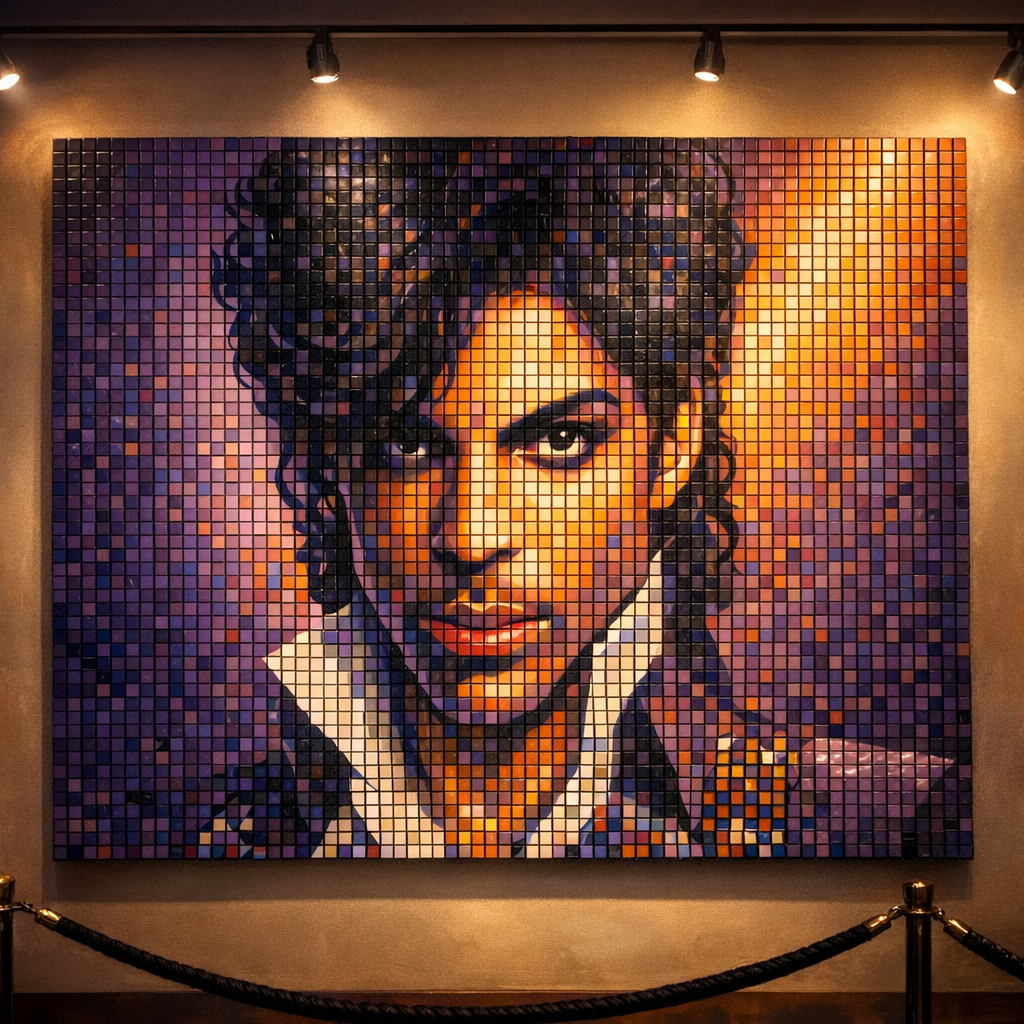
Prince Rubik’s Cube mosaic art combines one of the most recognizable icons of 80s pop culture with one of the decade’s most recognizable objects: the full-size 3×3 Rubik’s Cube.
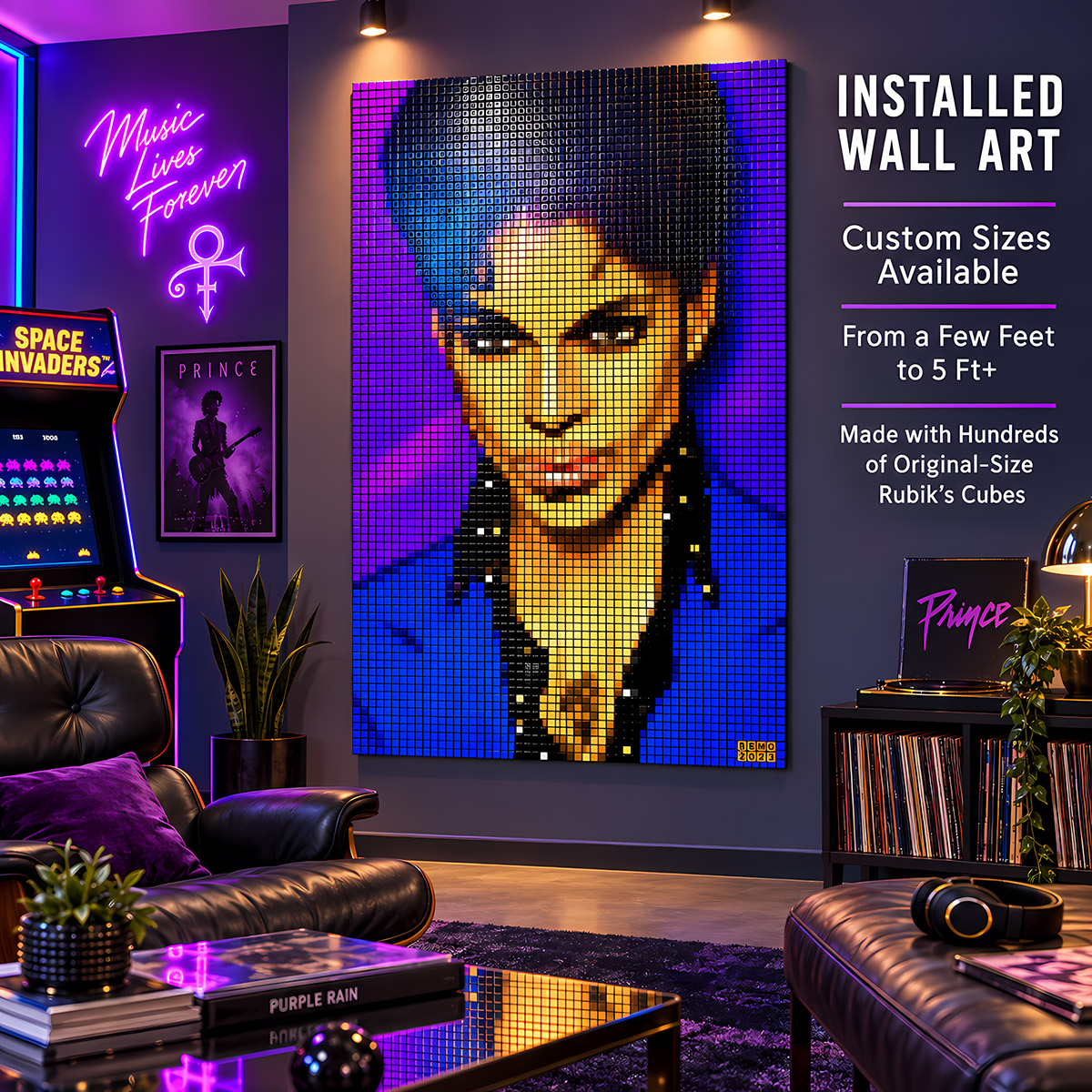
Brian Bemo’s featured Prince mosaic is not a flat print or digitally printed cube pattern. It is a physical, hand-built artwork assembled from 540 real, full-size Rubik’s Cubes, with each cube individually re-stickered to create a much broader range of colors than a standard cube palette.
The finished Prince portrait measures approximately 40 × 68 inches and weighs approximately 148 pounds, creating a dimensional statement piece that looks completely different from across the room than it does up close.
This article explains how the artwork was created, why custom colors matter, how pixelated and more realistic styles can be approached, where large cube mosaics work best, and how to commission your own custom Rubik’s Cube mosaic wall art from Brian Bemo.
What Makes This Prince Rubik’s Cube Mosaic Different?
Real full-size Rubik’s Cubes
The portrait is built from real, full-size 3×3 Rubik’s Cubes rather than mini cubes or a flat printed image designed to imitate a cube mosaic.
Up close, the individual cubes, seams, stickers, depth, and exposed cube edges remain visible.
Step back, and those individual components visually combine into the larger Prince portrait.
Custom colors beyond the standard cube palette
Traditional Rubik’s Cube mosaics are often restricted to a handful of factory colors.
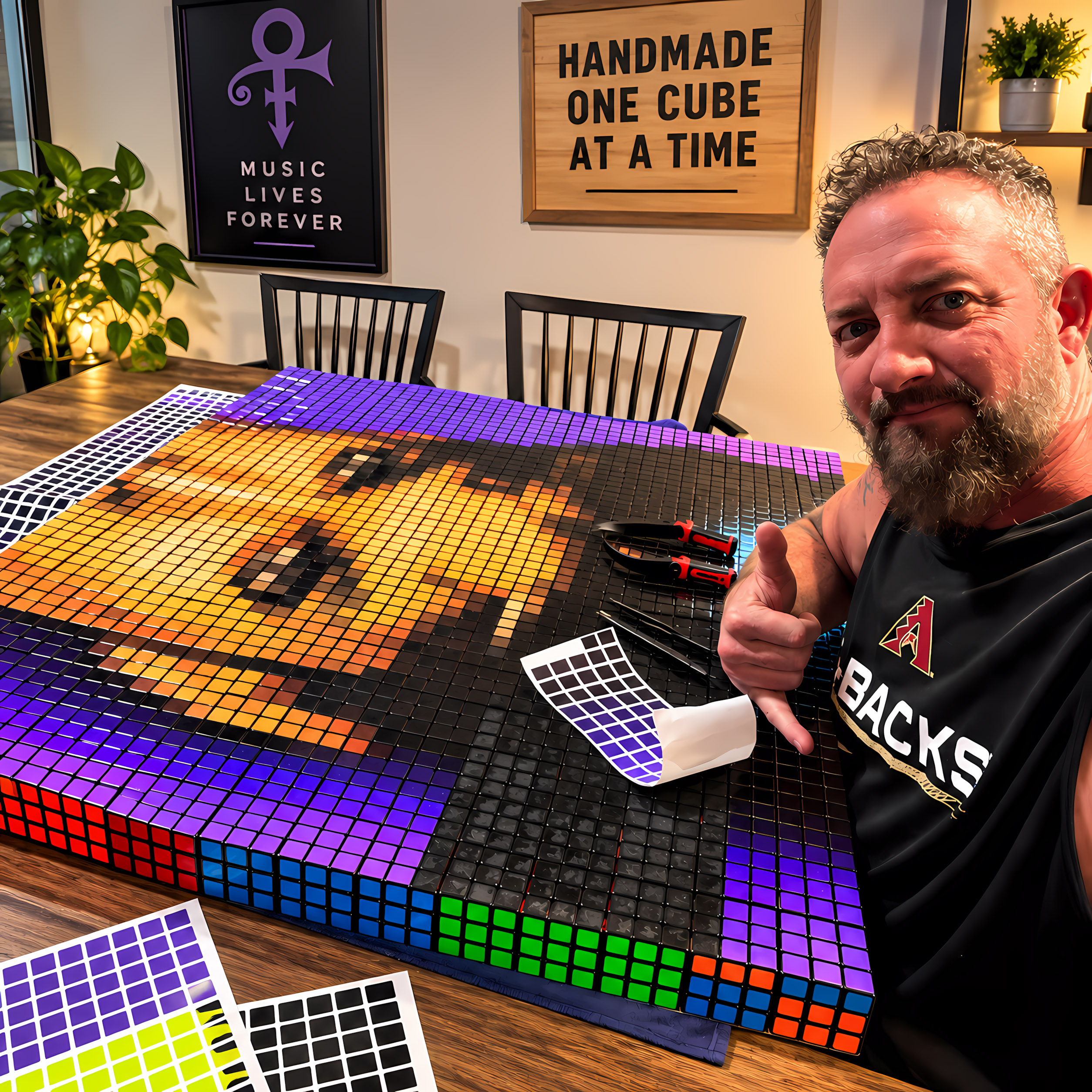
Brian individually re-stickers the cubes with custom color-matched decals based on the approved artwork, providing greater control over skin tones, shadows, highlights, clothing, backgrounds, and facial detail.
Hand-built one cube at a time
Designing the image is only the first stage.
The cubes must then be prepared, re-stickered, positioned, assembled, backed, and prepared for display as a finished physical artwork.
FEATURED PRINCE MOSAIC
Approx. 40 × 68 inches
Approx. 148 pounds
540 full-size Rubik’s Cubes
Custom re-stickered color palette
Custom backing and mounting system
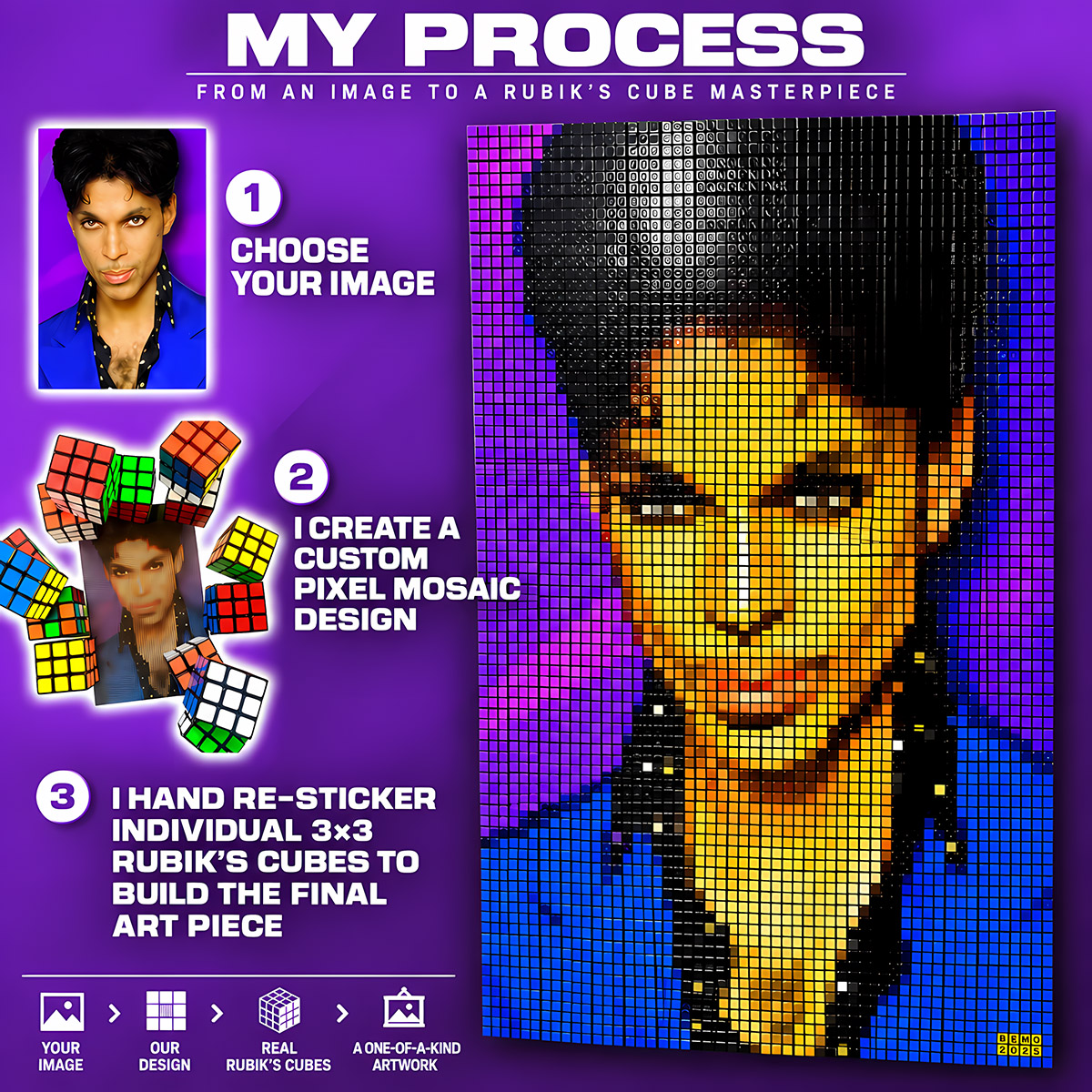
From a Source Image to a Finished Rubik’s Cube Portrait
A custom cube mosaic begins long before the first physical cube is placed.
- Choose the image or concept. The subject, composition, orientation, desired size, and intended display location are discussed.
- Create the mosaic artwork. The source image is redesigned specifically for a cube-based composition rather than simply enlarged and printed.
- Develop the color palette. Custom colors are planned for skin tones, highlights, shadows, clothing, backgrounds, and important details.
- Prepare the cubes. Individual cube faces are re-stickered according to the approved artwork.
- Assemble the mosaic. Hundreds of full-size cubes are positioned to form the final image.
- Complete the backing and display system. The finished artwork is prepared around its dimensions, weight, orientation, and intended installation.
See the complete finished artwork, close-up details, mounting options, and additional commission examples on the Prince and Custom Rubik’s Cube Mosaic Wall Art page.
Retro Pixel Art or a More Realistic Portrait?
A Rubik’s Cube mosaic does not have to follow only one visual style.
For collectors who want a strong retro look, the source artwork can be intentionally pixelated to emphasize the block-style aesthetic associated with early digital graphics, arcade games, and 80s and 90s visual culture.
For a more realistic portrait, more of the source image’s shading, color transitions, and facial detail can be preserved while still allowing the natural grid of the full-size cubes to remain visible.
Both approaches preserve what makes the medium distinctive: the image remains physically constructed from cubes rather than becoming a flat reproduction.
 Why Rubik’s Cubes Fit 80s & 90s Pop Culture So Well
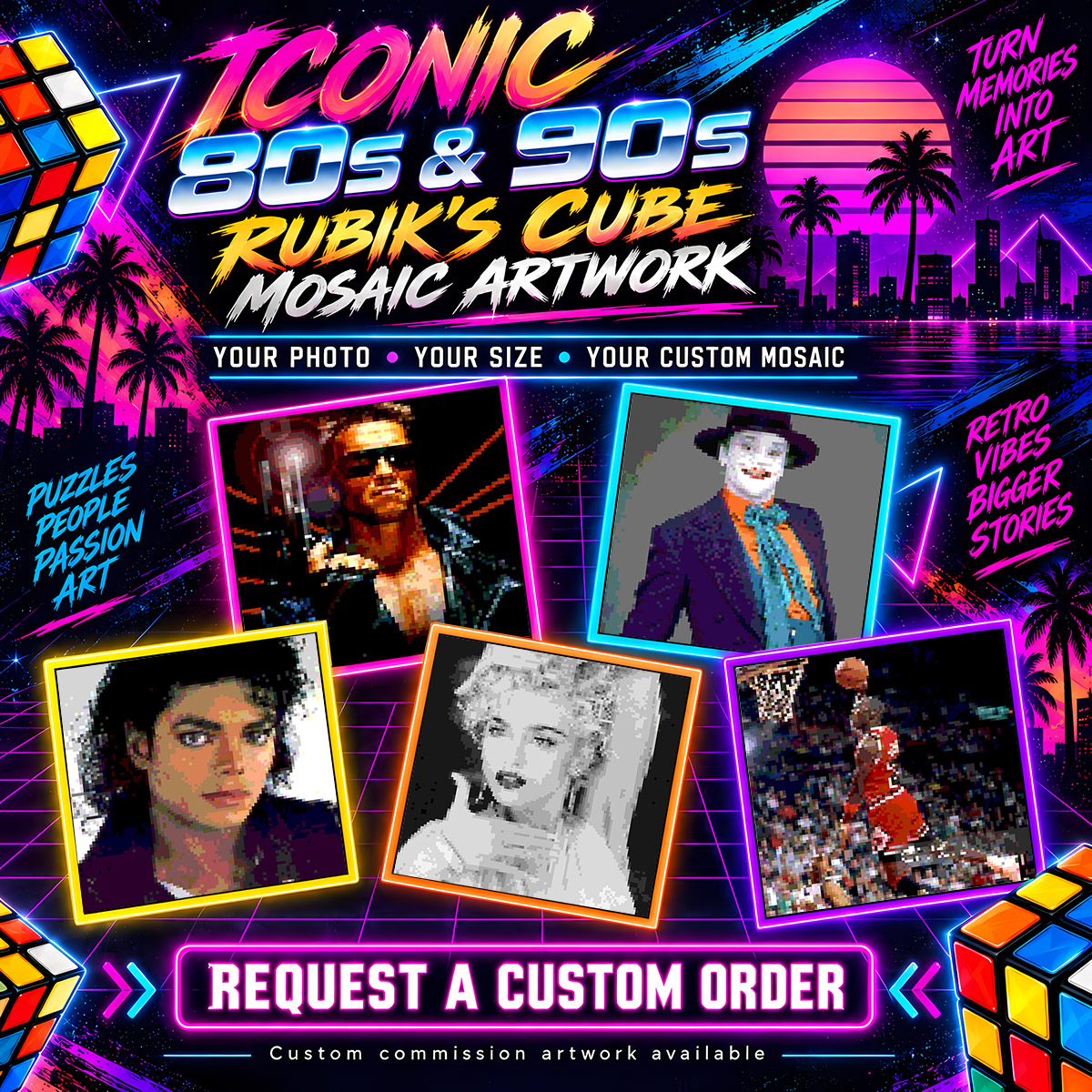
The Rubik’s Cube became a visual symbol of the 1980s, making it a natural material for artwork celebrating the music, movies, sports, games, and personalities associated with the era.
Prince is the featured example, but custom mosaic concepts can explore subjects such as Michael Jackson, Madonna, David Bowie, Freddie Mercury, Michael Jordan, Mr. T, Batman, the Joker, classic arcade imagery, Nintendo-era gaming, Pac-Man, Ms. Pac-Man, boomboxes, cassette culture, neon graphics, personal photographs, pets, logos, cars, and original artwork.
Named celebrities, characters, games, and brands are examples of subjects people may want to discuss. Individual commissions may require review of source-image rights, trademarks, licensing, or intended use.
Beyond Prince: What Can Be Turned Into Cube Mosaic Art?
The technique is not limited to celebrity portraits.
- 80s and 90s music icons
- Athletes and sports memories
- Movie and television imagery
- Retro arcade and gaming concepts
- Personal and family portraits
- Pet portraits
- Cars and motorcycles
- Landscapes and city skylines
- Company logos and brand artwork
- Original abstract compositions
- Restaurant and nightclub concepts
- Large commercial or public-space designs
The subject, dimensions, orientation, colors, and display approach can all be developed around the client rather than forcing every project into the same format.
Where Large Rubik’s Cube Mosaic Art Makes the Biggest Impact
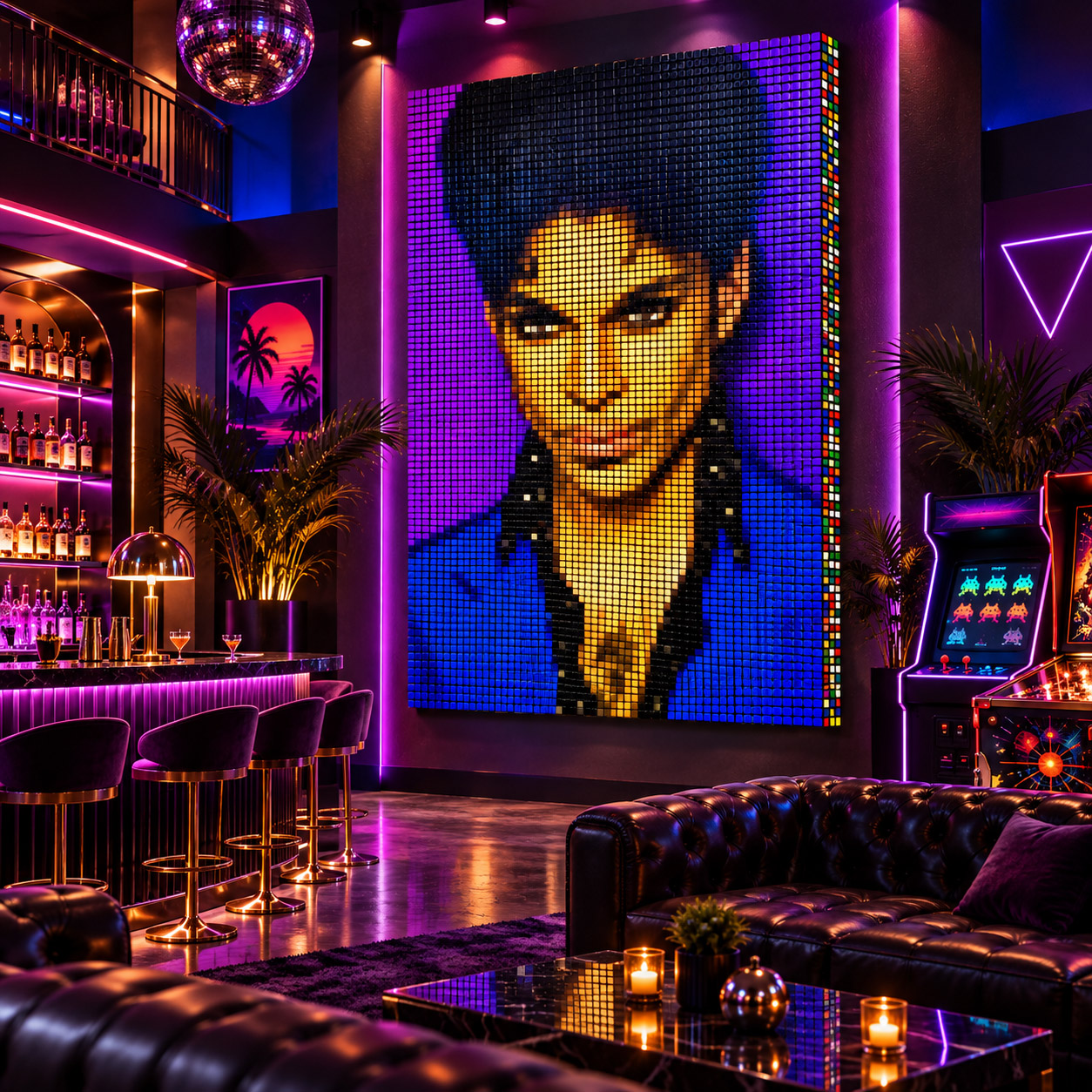
Because these mosaics have physical depth and can be built at substantial scale, they work especially well where the artwork is intended to become a focal point rather than background decoration.
- 80s and 90s game rooms
- Man caves
- Arcade rooms
- Music and vinyl rooms
- Home theaters
- Private collections
- Nightclubs and lounges
- Retro bars
- Restaurants and breweries
- VIP rooms
- Hotels and resorts
- Corporate lobbies
- Retail environments
- Shopping malls
- Galleries
- Entertainment venues
- Public-space art proposals
What Does “Collector-Grade” Mean for Cube Mosaic Art?
“Collector-grade” is not an official certification or guarantee of future resale value.
On this project, the term describes the combination of original design work, full-size physical cubes, extensive hand preparation, custom colors, substantial scale, limited production capacity, and a finished presentation intended to function as artwork rather than novelty décor.
Collectors may especially appreciate being able to commission a subject connected to their own memories, collection, room, or interests rather than purchasing a mass-produced design.
Brian Bemo’s Hands-On Build Process
Brian Bemo personally works on the design and physical creation of the mosaics rather than outsourcing the artistic concept and simply reselling a manufactured object.
The image below shows Brian working directly on the Prince mosaic during the re-stickering and assembly process.
Professional Frameless Mounting & Display
A large cube mosaic requires more planning than hanging an ordinary framed print.
The backing and mounting system is selected around the finished dimensions, cube count, orientation, wall type, and overall weight.
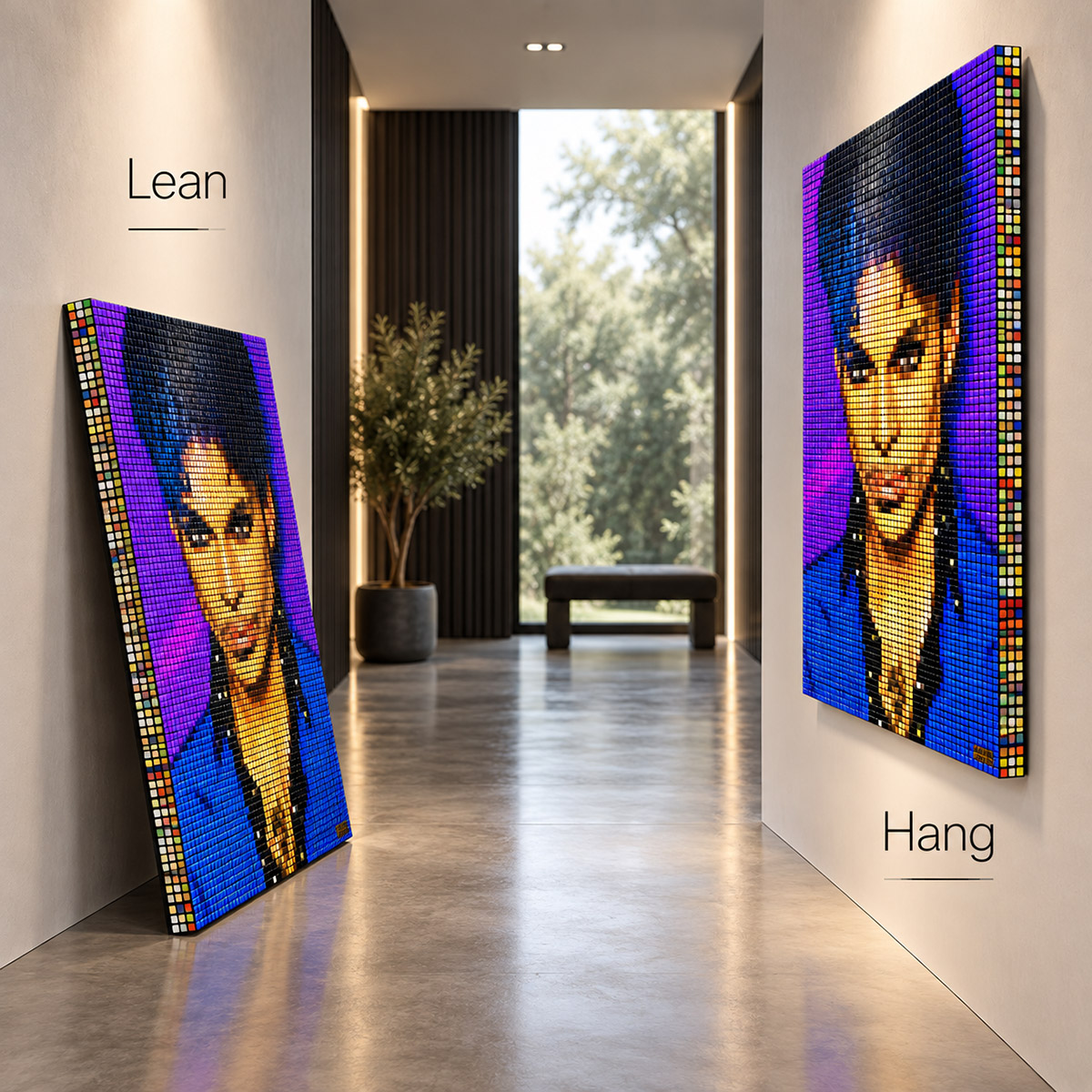
A minimal frameless presentation can keep attention on the cubes themselves while leaving their physical depth and original side colors visible.
Depending on the commission and location, possible presentation concepts can include wall mounting, horizontal or vertical formats, modular panels, or a properly supported leaning display.
See additional examples on the custom Rubik’s Cube wall-art portfolio and commission page.
How to Commission Your Own Rubik’s Cube Mosaic
Start with the image or idea you want transformed into artwork.
Useful information includes your source image, approximate finished dimensions, a photograph of the intended wall or room, destination, preferred completion date, and any mounting or installation requirements.
Brian can then discuss whether the image is suitable, recommended proportions, design approach, cube count, pricing, timeline, shipping, and display considerations.
Only a limited number of custom mosaic commissions can be built at a time.
Book a Call With Brian Bemo to Discuss Your Custom Mosaic →
Or view the featured artwork and current commission information:
View the Prince Rubik’s Cube Mosaic on Etsy →
Frequently Asked Questions About Prince & Custom Rubik’s Cube Mosaic Art
Prince Mosaic, Materials & Craftsmanship
1. What is Prince Rubik’s Cube mosaic art?
Prince Rubik’s Cube mosaic art is a physical portrait created by arranging full-size 3×3 cubes into a larger image of Prince. Brian Bemo’s featured artwork also uses custom re-stickering to achieve colors beyond the normal cube palette.
2. Is the Prince artwork a print or a real Rubik’s Cube mosaic?
It is a physical mosaic made from real full-size cubes. Digital artwork is used during the design and planning stage, but the finished wall piece is assembled from hundreds of three-dimensional cubes.
3. How many cubes are in the featured Prince mosaic?
The featured artwork uses 540 full-size Rubik’s Cubes and measures approximately 40 × 68 inches.
4. How much does the Prince Rubik’s Cube mosaic weigh?
The featured Prince build weighs approximately 148 pounds. Other commissions can weigh substantially more or less depending on dimensions, cube count, backing, and construction.
5. Why are custom stickers used on the cubes?
Custom color-matched stickers provide more control over skin tones, shadows, highlights, clothing, and backgrounds than the limited standard cube palette.
6. Does the artwork still look like real Rubik’s Cubes after re-stickering?
Yes. The visible grid, seams, cube depth, individual squares, and original side colors preserve the physical character of the cubes even though the front-facing image uses a custom palette.
7. Who made the featured Prince Rubik’s Cube artwork?
Brian Bemo of Bemo Design designed and hand-built the featured Prince mosaic, including the artwork preparation, color planning, re-stickering, assembly, and finished presentation.
8. Is the Prince artwork officially licensed?
The featured Prince mosaic is independently created artwork and is not presented as an officially licensed Prince product. Rights and source-image considerations are reviewed separately for individual commissions.
Custom Portraits, Music, Sports & Retro Subjects
9. Can I commission a custom mosaic instead of Prince?
Yes. Prince is the featured example, but commissions can explore personal portraits, pets, musicians, athletes, vehicles, landscapes, logos, retro concepts, and other approved imagery.
10. Can I commission Michael Jackson Rubik’s Cube artwork?
A Michael Jackson portrait concept can be discussed as a potential commission. Image rights, source material, intended use, scale, and composition would be reviewed before the project is accepted.
11. Can you create Madonna, David Bowie or Freddie Mercury portraits?
Music portrait concepts can include recognizable 80s and 90s performers such as Madonna, David Bowie, or Freddie Mercury. The strongest design depends on the selected photograph, crop, dimensions, and desired visual style.
12. Can I commission Michael Jordan or another sports legend?
Sports portraits and action scenes can be explored for game rooms, sports collections, offices, and entertainment spaces. Michael Jordan-style basketball imagery is one example of a subject that can translate into a high-contrast cube composition.
13. Can you create Batman, the Joker or Mr. T-inspired artwork?
Movie, television, and character-inspired concepts can be discussed as custom subjects. Specific branded characters and celebrity likenesses may require review of rights and intended use before a project is accepted.
14. Can you make Nintendo, Mario, Pac-Man or Ms. Pac-Man-inspired art?
Retro gaming can inspire cube mosaics for game rooms and arcade spaces. Specific protected characters or branded imagery are reviewed individually, while original arcade and 8-bit-inspired concepts can also be created.
15. Can you make a Rubik’s Cube portrait from my personal photo?
Yes. Personal portraits, family photographs, wedding images, memorial portraits, pets, and other meaningful photographs can be considered for a custom design.
16. Can a business commission its logo as Rubik’s Cube wall art?
Yes. Authorized company logos, branded imagery, mascots, founders, products, or original compositions can be developed for offices, restaurants, bars, retail spaces, and other commercial interiors.
Game Rooms, Man Caves, Bars & Statement Interiors
17. Is Rubik’s Cube mosaic art a good centerpiece for an 80s game room?
It can be especially effective in a retro game room because the Rubik’s Cube itself is closely associated with the 1980s and the grid naturally complements arcade and early digital aesthetics.
18. What makes custom cube art work well in a man cave?
The artwork can be built around the owner’s actual interests rather than generic décor, including music, sports, movies, gaming, cars, personal photographs, or memorabilia themes.
19. Can a nightclub use Rubik’s Cube mosaic art as a feature wall?
A large mosaic can become a focal point in a suitable nightclub, lounge, or entertainment venue. Size, visitor access, lighting, wall structure, and installation requirements should be reviewed for the specific location.
20. Would custom cube art work in an 80s or 90s retro bar?
Yes. Music, gaming, cassette culture, boomboxes, neon-inspired graphics, portraits, and original throwback compositions can reinforce an 80s or 90s environment without relying on generic mass-produced décor.
21. Can restaurants or breweries commission custom Rubik’s Cube artwork?
Yes. A restaurant, brewery, or live-music venue can discuss artwork based on its branding, local culture, entertainment theme, founder, or original visual concept.
22. Can this artwork work in a luxury home or penthouse?
A custom mosaic can be planned for a private collection, music room, game room, home theater, hallway, or large feature wall when the scale and subject complement the interior.
23. Can malls, lobbies or public spaces commission larger cube installations?
Potential commercial and public-space projects can be discussed, including multi-panel concepts. Site dimensions, structural requirements, access, safety, maintenance, and installation scope must be reviewed before feasibility is confirmed.
24. Can an interior designer or architect specify a Bemo mosaic for a project?
Yes. Designers and architects can contact Brian during the planning stage to discuss artwork dimensions, visual direction, display conditions, and coordination with the larger interior or architectural project.
Design Style, Size, Mounting & Ordering
25. Can Rubik’s Cube mosaic art look intentionally pixelated?
Yes. The source artwork can be intentionally simplified into a bold retro pixel aesthetic that emphasizes the connection to arcade graphics, early digital imagery, and 80s or 90s nostalgia.
26. Can a Rubik’s Cube portrait look more realistic?
Yes. The design can retain more shading, color transitions, and facial detail from the source image while still preserving the visible cube grid and three-dimensional construction.
27. How large can custom Rubik’s Cube wall art be?
Finished dimensions depend on the artwork, desired detail, available space, cube count, weight, transport, and installation requirements. Larger or multi-panel concepts can be evaluated for appropriate projects.
28. How is heavy Rubik’s Cube mosaic artwork mounted?
The backing and mounting approach is planned around the finished weight, dimensions, wall type, orientation, and location. Heavy artwork should not be treated like an ordinary framed picture.
29. Can a cube mosaic be displayed without a traditional frame?
Yes. A minimal frameless presentation can keep the cubes visually dominant while showing their physical depth and exposed side colors. Final edge treatment is determined during the commission.
30. How much does a custom Rubik’s Cube mosaic cost?
Pricing depends on dimensions, cube count, design complexity, custom color preparation, backing, delivery, and installation requirements. Custom projects are quoted individually.
31. How long does a custom Rubik’s Cube commission take?
Timing varies according to design approval, size, cube preparation, complexity, and Brian’s current commission schedule. Discuss a required completion date before ordering.
32. How do I commission my own Rubik’s Cube mosaic from Brian Bemo?
Share the subject or image, approximate dimensions, intended location, destination, and preferred timeline. Brian can then discuss feasibility, design direction, pricing, mounting, shipping, and next steps.
Ready to Create Your Own Rubik’s Cube Mosaic?
Prince demonstrates what is possible with the medium, but your commission can be completely different.
Bring your favorite photograph, portrait, retro memory, business concept, game-room idea, music inspiration, or original artwork and discuss how it could become a physical mosaic made from real full-size cubes.
Explore Custom Rubik’s Cube Wall Art & Commission Options →
Book With Brian Bemo for a Custom Commission →
View the Prince Rubik’s Cube Mosaic on Etsy →
About the Artist
Brian Bemo is the owner of Bemo Design in Scottsdale, Arizona, with more than 25 years of professional creative, web, branding, and design experience. His custom Rubik’s Cube mosaic work combines digital artwork preparation with extensive hands-on re-stickering, physical assembly, and presentation.