
How to Get My Business in ChatGPT: 7 Ways to Be Recommended
Jump to section
When a potential customer asks an AI tool, “Who should I hire near me?” your business needs more than a nice-looking website. It needs clear, trustworthy information that AI systems can find, understand, and connect to the customer’s question.
That is the practical answer to how to get my business in ChatGPT. You cannot submit a business listing directly to ChatGPT or buy a guaranteed recommendation. You can, however, build the technical access, local proof, useful content, and authority signals that make your business easier to surface when ChatGPT uses web information.
The Short Answer: Make Your Business Easy to Verify
ChatGPT can use current web information to answer questions, including local and service-based questions. OpenAI states that any public website can appear in ChatGPT results, but that visibility is not guaranteed and depends on relevance, reliability, and whether its crawler can access your content. As OpenAI puts it, “There is no way to guarantee top placement.” Read OpenAI’s guidance for publishers.
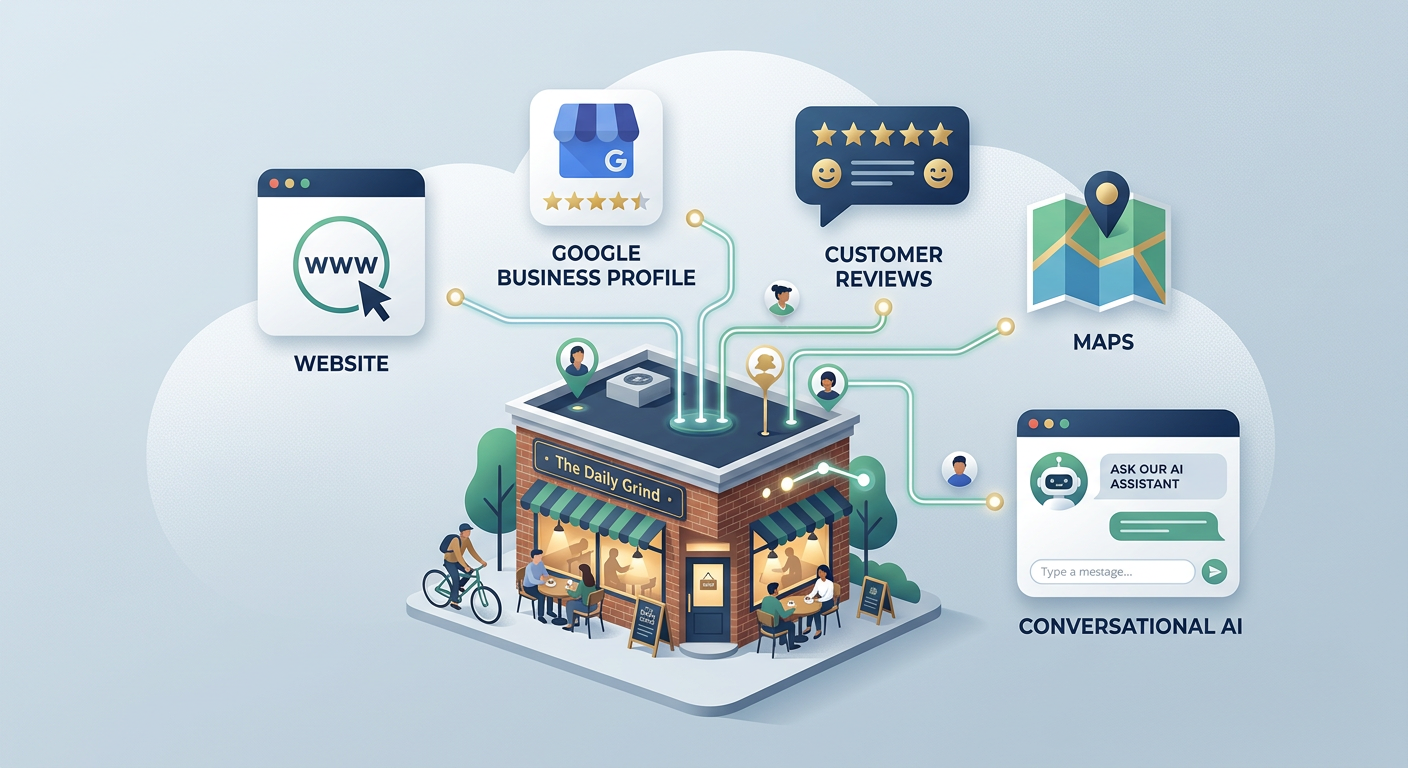
For most local businesses, the strongest path is not a shortcut. It is a connected visibility system that includes:
- A fast, crawlable website with clear services and locations
- Accurate Google Business Profile and directory information
- Helpful pages that answer real buyer questions
- Strong reviews and third-party credibility
- Clear business entities, schema markup, and internal links
- Consistent proof that your business serves the market it claims to serve
| Priority | What to Improve | Why It Matters | Best First Move |
|---|---|---|---|
| Website access | Crawlability and indexation | Lets AI systems find pages | Check robots.txt and hosting rules |
| Entity clarity | Services, location, ownership | Reduces confusion | Update core business information |
| Local trust | Reviews and profiles | Supports recommendations | Strengthen Google Business Profile |
| Content depth | Service and FAQ pages | Answers buyer questions | Publish useful, specific pages |
| Authority | Links and mentions | Builds confidence | Earn credible local mentions |
1. Make Sure ChatGPT Can Access Your Website
Before working on content, confirm that your site is available to the systems that may retrieve and summarize public web pages. If your robots.txt file, security plugin, content delivery network, or firewall blocks OpenAI’s web crawler, ChatGPT may have limited ability to discover and use your pages.
OpenAI specifically advises publishers to allow OAI-SearchBot if they want their content considered for ChatGPT summaries and snippets. Ask your web developer to review your robots.txt rules, server logs, and bot protection settings. Do not blindly open every bot, but do make an informed technical decision based on your visibility goals.
Your website should also have:
- One preferred version of each page
- Clear page titles and descriptions
- Mobile-friendly layouts
- Fast loading pages
- No accidental noindex tags on important service pages
- XML sitemap coverage for core pages
For a deeper technical and content roadmap, review our guide on how to show up in ChatGPT.
2. State Exactly What You Do, Where You Work, and Who You Help
Vague language makes it hard for people and AI systems to understand your business. “We deliver exceptional solutions” does not explain whether you are a Scottsdale cosmetic dentist, Phoenix roofer, Paradise Valley estate attorney, or multi-location HVAC company.
Your homepage, service pages, location pages, and contact page should clearly identify your primary services, service areas, ideal customers, business name, and contact details. Use natural language that matches how customers ask questions, including phrases such as “emergency plumber in Phoenix,” “family law attorney in Scottsdale,” or “luxury home builder in North Scottsdale.”
This is not about repeating a city name on every line. It is about helping your site communicate genuine local relevance and specialized expertise. If you serve multiple cities, create useful location pages only where you can add real details, proof, services, and examples.
3. Strengthen Your Google Business Profile and Local Footprint
For local recommendations, your Google Business Profile, Google Maps presence, reviews, local citations, and website should tell the same story. Inconsistent phone numbers, outdated addresses, missing categories, and weak review profiles create uncertainty that can hold back your visibility across Google and AI-powered answers.
Start with the fundamentals:
- Select the most accurate primary business category
- Complete services, service areas, hours, and contact information
- Add original photos that show your team, location, work, or products
- Request reviews consistently and respond professionally
- Keep your business information consistent across major directories
- Link your profile to the most relevant page on your website
A Google Business Profile is not a substitute for a strong website. It is a corroborating source. When your profile, customer reviews, local listings, and website agree, your company becomes easier to trust.
If you are unsure where competitors are pulling ahead, use a free local SEO, Google Maps, and AI audit to identify gaps in local visibility.
4. Create Pages That Answer the Questions Buyers Ask
A common mistake is publishing broad, generic blogs that attract readers but do not help a business get chosen. ChatGPT visibility improves when your public content answers clear questions with specific, useful information.
Build content around the moments before a customer contacts you. For example, a dental practice can explain implant eligibility, recovery expectations, financing questions, and how to choose a provider. A roofing company can cover storm damage inspections, insurance documentation, repair versus replacement, and service-area timelines.
Use a Progressive Content Plan
For growth-stage businesses, we recommend building content in this order:
- Core service pages that explain each high-value offer.
- Location and service-area pages for markets you genuinely serve.
- Decision pages that compare options, costs, timelines, and qualifications.
- Proof pages featuring case studies, before-and-after work, credentials, and process details.
- FAQ content that directly addresses objections and common questions.
Each page should have a clear purpose, original expertise, and a next step. A page that simply restates information already found everywhere else gives customers little reason to trust it or act on it.
5. Add Structured Data and Strong Internal Links
Schema markup helps machines interpret the information already visible on your website. For a local company, that can include business name, address, phone number, business type, services, reviews, operating hours, and service areas where appropriate.
Schema alone will not make your business appear in ChatGPT. Think of it as a clarity layer. It works best when your visible content, local profiles, and third-party information are already accurate.
Internal linking matters for the same reason. A strong service page should link to supporting FAQs, relevant location pages, case studies, and contact options. This gives visitors a clearer path through your site and reinforces the relationship between your expertise, services, and markets.
Businesses that want a broader framework can learn more about GEO AI SEO services, which combine technical SEO, entity clarity, content authority, and AI search visibility work.
6. Earn Reviews, Mentions, and Independent Proof
AI tools are designed to help users find reliable answers. Your own website is essential, but independent proof helps validate your claims. For a local business, that proof may come from customer reviews, professional associations, local media, chamber listings, supplier profiles, industry publications, or credible community partnerships.
Focus on quality and relevance. A few meaningful mentions from real local or industry sources are more useful than a pile of low-quality directory listings. Never purchase fake reviews or mass-produce low-value links. Those tactics create risk without building real trust.
We also recommend turning real customer questions into useful public content. The questions people ask during estimates, consultations, or sales calls often become your best FAQ topics, because they reveal the hesitation that stands between interest and a decision.

7. Test Real Prompts and Improve What AI Systems Miss
Do not assume your business is visible just because you rank for your own brand name. Test the kinds of prompts a customer might use when they do not know your company yet.
Try questions such as:
- Who are reputable estate planning attorneys in Scottsdale?
- What is the best way to find an emergency HVAC company in Phoenix?
- Which cosmetic dentists offer dental implants near Paradise Valley?
- What should I look for when hiring a commercial roofer?
Look for patterns. Is your company absent? Is it described incorrectly? Are competitors consistently mentioned because they have stronger reviews, better service pages, more authoritative coverage, or clearer local signals?
Then improve the underlying information. Avoid trying to manipulate the response with thin pages or exaggerated claims. The goal is to become the most understandable and credible option, not to chase a single answer.
What to Do If Your Business Is Not Showing Up
If you are asking how to get my business in ChatGPT because competitors keep appearing first, start with an honest audit. Most visibility problems come down to a mix of weak content, unclear services, technical barriers, sparse local proof, inconsistent listings, or limited authority.
Bemo Design helps businesses identify those gaps across Google Search, Google Maps, Google Business Profile, and AI platforms. Our AI SEO services in Scottsdale are built for companies that want qualified leads, not vanity metrics or generic reports.
Questions Business Owners Ask About ChatGPT Visibility
Can I submit my business directly to ChatGPT?
No. There is no standard business-submission form that guarantees inclusion in ChatGPT answers. The practical approach is to make your website public, crawlable, accurate, useful, and supported by trustworthy third-party information.
Does a Google Business Profile put my business in ChatGPT?
Not by itself. A complete Google Business Profile supports local credibility, but it should work alongside a strong website, reviews, consistent business listings, and clear service information.
How long does it take to show up in ChatGPT?
There is no fixed timeline. Website improvements can be indexed and recognized at different speeds, while recommendation-style visibility usually depends on broader authority, relevance, and competition in your market.
Will SEO help my business appear in AI answers?
Yes, strong SEO supports many of the signals AI systems need, including crawlability, relevant content, trusted mentions, clear entities, and user-focused pages. AI visibility is not separate from SEO, it is an expansion of the work required to be found and understood.
Do reviews matter for ChatGPT recommendations?
Reviews can matter, especially for local and service-based decisions, because they provide public evidence of customer experience. Focus on consistently earning genuine reviews rather than chasing an artificial volume target.
Should I create a page for every city I serve?
Only if each page provides unique value. Strong city pages include relevant services, local details, proof of service, useful FAQs, and a clear reason for customers in that area to choose you.
See Where Your Business Is Missing Opportunities
If your company is not being mentioned when customers ask AI tools who to hire, we can help you find out why. Run a free AI SEO and website audit or book a free strategy call with Bemo Design to build a practical visibility plan around the leads you want to earn.
You can also call (480) 600-2477 to discuss your website, Google visibility, and AI search opportunities directly.
The Bottom Line
Showing up in ChatGPT is not about finding a secret submission button. It is about becoming a business that the web can clearly verify and confidently describe, through accessible pages, accurate local information, useful answers, real reviews, and sustained authority.
The companies that make this work do not treat AI visibility as a one-time project. They continuously improve the information customers use to evaluate them. Build that foundation, measure what is missing, and give both people and AI systems strong reasons to recommend your business.
About Bemo Design
Bemo Design is a Scottsdale-based SEO, AI search, Google Ads, Local SEO, and digital marketing company led by Brian Bemo. With more than 25 years of experience, we help businesses increase visibility across Google Search, Google Maps, Google Business Profile, ChatGPT, Google AI, Gemini, Claude, Perplexity, Bing/Copilot, and other AI search platforms.
Our strategy combines traditional SEO, GEO AI SEO and AI search optimization, Google Business Profile optimization, Google Maps visibility, reviews, content, schema, authority building, Google Ads, and conversion-focused web design.
The goal is simple: help businesses get found, trusted, recommended, and chosen, then turn that visibility into real calls, leads, appointments, and customers.
Explore Bemo Design’s AI Resources
See How Your Business Is Performing
Ready to Get More Leads?
Call (480) 600-2477 or book a free strategy call.