
How Much Should a Small Business Spend on PPC, 2026 Guide Now

How you set a PPC budget can make or break early growth. Small businesses need a plan that balances lead volume, cost per acquisition, and long-term value, not guesswork. In this guide you'll get clear rules of thumb, a step-by-step budgeting method, and real-world examples so you can decide how much to spend without wasting ad dollars.
how much should a small business spend on ppc is the central question we answer with practical, local-first advice tailored to service businesses, dental and medical practices, real estate firms, and other small-to-mid-sized companies.
Quick summary
This article explains how to set a PPC budget using three approaches: percentage of revenue, target-acquisition-based, and test-and-scale. You get step-by-step calculations, sample budgets for common small business scenarios, tips to cut wasted spend, and measurement checkpoints to protect ROI.
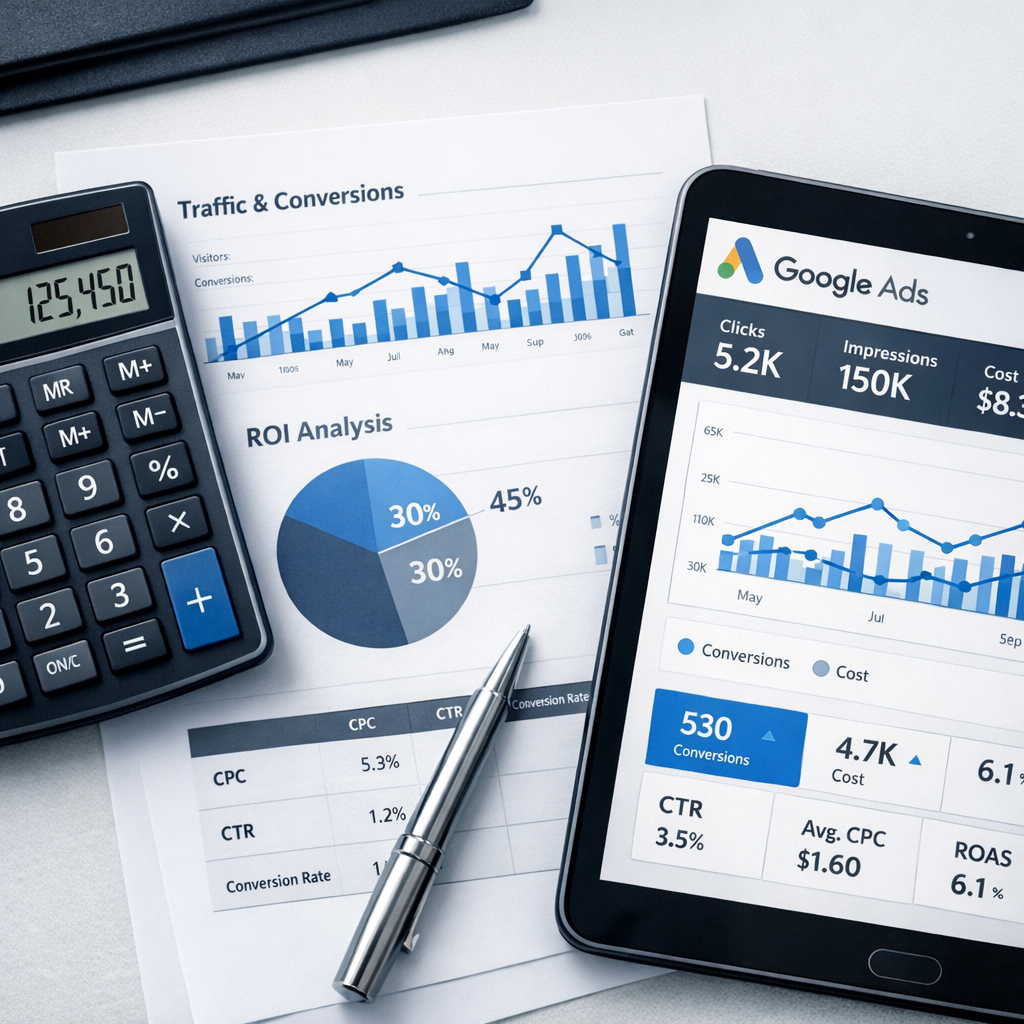
Why a thoughtful PPC budget matters
Here is the thing, PPC gives fast visibility, but sloppy budgets burn cash fast. Spend too little and you miss enough clicks to move the needle, spend too much without tracking and you pay for worthless traffic. A good budget aligns with your business goals, lifetime customer value, and how quickly you need results.
Brian Bemo and our team at Bemo Design bring 25+ years of hands-on marketing experience, working directly with business owners to set realistic PPC budgets and measure the results. You can always reach us at https://bemodesign.com/contact-bemo-design/ or call us at tel:480-600-2477.
Three practical methods to set your PPC budget
1) Percentage of revenue method
- Typical range: 5% to 12% of gross annual revenue for marketing, with 10% of that reserved for PPC when you are scaling paid ads. If you need immediate leads, allocate toward the higher end.
- Example: If annual revenue is $500,000 and you set 10% for marketing, you have $50,000. Allocating 20% of marketing to PPC gives $10,000 per year, or about $833 per month.
- Best when you have stable revenue and want predictable, controlled spending.
2) Cost-per-acquisition (CPA) target method
- Start with your average sale value and desired profit margin to derive an acceptable CPA. CPA = (Average Sale Value x Gross Margin) x Acceptable Acquisition Cost Percentage.
- Example: Dental practice with a new patient worth $400 in first-year revenue, gross margin 60%, and willing to spend 25% of first-year revenue to acquire the patient: CPA allowed = $400 x 0.60 x 0.25 = $60.
- Use historical conversion rates to translate CPA into monthly ad spend and clicks. If landing page conversion is 5%, you need 20 clicks to get one lead, so cost-per-click target = CPA / 20 = $3.
- Best for businesses with clear transaction values and stable conversion data.
3) Test-and-scale method, recommended for new accounts
- Start small, $500 to $2,000 over a 30-90 day test window, depending on industry competitiveness.
- Measure cost per lead, conversion rate, and lead quality. After 60-90 days, increase budget by 20% to 50% monthly where ROI is positive.
- This minimizes upfront risk and produces real CPC and conversion data to set long-term budgets.
Example budget scenarios for small businesses
- Local service (plumber, HVAC): Starting test budget $1,000/month, scale to $2,500–$6,000/month once CPA stabilizes.
- Dental/medical practice: Start $1,500–$3,000/month, scale to $5,000–$10,000+ if lifetime patient value and retention justify spend.
- Real estate agent/team: Start $1,000–$2,500/month for lead-gen, scale heavily during peak selling seasons.
- B2B professional services (legal, consulting): Start $1,500/month and expect higher CPAs, with budgets often $3,000–$8,000/month for meaningful pipeline growth.
How to translate goals into numbers, step-by-step
- Calculate average revenue per customer and gross margin.
- Decide acceptable payback period and target ROI.
- Set target CPA from step 1 and 2.
- Use expected conversion rates to forecast clicks and CPC targets.
- Build a 90-day test budget that delivers enough clicks to validate your assumptions.
Ways to reduce wasted PPC spend
- Use negative keywords and geographic targeting to avoid irrelevant clicks.
- Separate campaigns by intent and landing page so you can measure accurately.
- Use conversion tracking and phone call tracking for service industries.
- Run A/B tests on ads and landing pages, then scale winners.
- Consider remarketing to reduce cost per conversion and increase lifetime value capture.
Measuring success and when to scale
- Track cost per lead, cost per acquisition, and return on ad spend (ROAS).
- If CPA is below your target and lead quality is good, scale budgets gradually by 20% to 50% each month.
- If CPA increases or lead quality drops, audit keywords, bids, and landing experience before cutting spend.
FAQs
How much should a small business spend on PPC each month?
It depends, but many small businesses start in the $500 to $2,000 range for testing. Service businesses and clinics often budget $1,000 to $5,000 monthly once campaigns are proven.
What percentage of revenue should I allocate to PPC?
For overall marketing, small businesses commonly allocate 5% to 12% of revenue. If PPC is a primary growth channel, plan for 15% to 40% of your marketing budget to go to PPC depending on your goals.
How long should I test before increasing my PPC budget?
Run a meaningful test for 60 to 90 days to gather conversion and quality data. Shorter tests often produce misleading results.
Can I run PPC with a $300 monthly budget?
Yes, but expect limited reach. Use a razor-focused geographic and keyword strategy to maximize ROI while testing.
How do I know if PPC spend is working?
Look at cost per acquisition compared to customer lifetime value, and track conversion rates and lead-to-customer close rates. Positive ROI over a consistent 90-day window indicates you can scale.
Ready to optimize your PPC budget
If you want a practical, numbers-based PPC budget built around your business, Brian Bemo will work directly with you. Book a free consultation today at https://calendly.com/bemodesign or call tel:480-600-2477. We also offer a free AI SEO Audit to reveal search opportunities at https://bemodesign.com/free-geo-ai-seo-audit/.
Conclusion
PPC budgets are not one-size-fits-all. Use a revenue percentage, CPA goal, or test-and-scale approach to find what works for your business. Start small, measure carefully, and scale the channels that deliver real, profitable customers. Bemo Design offers hands-on PPC and Google Ads management in Scottsdale, with experienced guidance from Brian Bemo and a focus on measurable results.
About Bemo Design
Bemo Design is a Scottsdale-based marketing agency led by Brian Bemo, delivering high-impact SEO, Google Ads, and AI-powered marketing strategies for businesses of all sizes. With over 25 years of experience, Bemo Design helps companies grow through trusted, hands-on service, transparent communication, and measurable results.
We specialize in helping Arizona businesses dominate online search and future-proof their visibility across Google, Bing, and AI-driven platforms like ChatGPT and Google SGE.
Our Top Services:
- SEO Services – Proven strategies to increase visibility and attract high-intent customers.
- GEO AI SEO – Generative Engine Optimization for ChatGPT, Google SGE, and AI-driven search results.
- Google Ads Management – Precision-targeted campaigns designed for conversions and ROI.
- Web Design – AI-optimized, mobile-friendly WordPress sites built to perform.
- Website Redesign – Modern updates that improve performance, SEO, and conversions.
- Logo Design & Branding – Visual identity that builds trust and recognition.
- Graphic Design & Print – High-quality creative design for web and print materials.
Ready to Grow?
📞 Call (480) 600-2477 or Book a Call with Bemo to get started. You can also run a Free AI SEO Audit to see how your website ranks and what opportunities you’re missing.


